THE STORY OF THE ST. PETER’S SCHOOLS TOLD IN THE YEAR OF THEIR CENTENARY
Ever since the days when, in 597 A.D. Augustine set foot in Kent with the Bible in one hand and a Latin grammar in the other, education has been one of the special cares of the Church.
Those of you who read this booklet will realize how that care has been honoured in the case of Newton-in-Makerfield, and how well the Church School and staff have served the community during its one hundred years’ existence.
Now that we celebrate St. Peter’s School Centenary with pride, we look to the future, and in thanksgiving for the achievements of the past, set ourselves the task of safeguarding its life. This age of change presents us with a challenge – that of so imparting knowledge that is seen as the revelation of God, and so using it that it glorifies His name and benefits His children.
Church and School must go forward hand in hand. Creed and curriculum must march together, for one without the other makes for but lame progress. The Book of Proverbs, which has been described as the oldest handbook of education has as its central thought – “Life is discipline, God educates men, and men educate each other.” From that book we can take words which concisely express the fundamental principle of our Church School – “The fear of the Lord is the beginning of wisdom,” and our aim should be to impart to future generations of children, as Wordsworth puts it,
“The rudiments of letters, and inform The mind with moral and religious truth.”
D. Donald Roberts, Vicar.
Challenge and Change
The St. Peter’s Schools, 1860 – 1960
by Lynton J. Smith, M.A., F.R.G.S.
in association with H. Bradbury, J. Harding and D. D. Roberts
Celebrations
Sunday, 26th June to Sunday, 3rd July, 1960
Trustees
The Original Trustees
Reverend Peter Legh, Vicar of St. Peter’s Church
William John Legh, Lord of the Manor
George McCorquodale
Meyrick Bankes
Joseph Hornby Birley
William Caunce
Trustees after the School were opened in 1860
The Vicar: Reverend Peter Legh
Church Wardens: Adam Cartwright
William Poulson
Trustees 1960
The Vicar: Reverend David Donald Roberts, B.A., C.F.
Church Wardens: Thomas Howarth
Allan H. Gandy
The Managers
No Records between 1860 and 1865
Records begin 1865
The Vicar: Reverend Thomas Whitley, Lieut. Col. McCorquodale, Captain Birley, J. C. Bailey, Esq.
Correspondent: Dr. J. W. Watkins
1960
The Vicar: Reverend D. Donald Roberts, B.A., C.F.
Foundation Managers: T. Howarth, Esq. A. J. Green, Esq. A. Davies, Esq.
Appointed by the Local Council: Councillor E. J. Thompson
Appointed by the Education Committee: H. Brailey, Esq.
Correspondent: W. J. Whitehead, Esq.
Headmasters
Boys School
1860-1865 – George Armitage
Records begin
1865-1871 – Alfred Smith
1871-1875 – John Smalley Foister
Boys and Girls Schools become Mixed School, July 26th, 1875
1875-1876 – John Smalley Foister
1876-1885 – Walter Maskell
1886-1905 – James Singleton
1905-1936 – Joseph Arthur Gee
1936-1943 – Ernest Edward Mason
St. Peter’s Church of England Junior and Infants School
1944 – Ernest Edward Mason
Headmistresses
Infants and Girls School
1860-1870 – The Misses Fazakerley
Records begin
1870-1873 – Jane Fazakerley
1873-1875 – Alice Anne Hayes
Infants School
1875-1877 – Alice Anne Hayes
1878-1879 – Elizabeth Ellen Hesketh
1879-1886 – Catherine Fazakerley
1886-1889 – Clara Devereux
1889-1891 – Hannah Caldwell
1891-1895 – Miriam Liptrott
1896 – Annie Duff (temporary)
1896-1900 – Sarah Emily Frost
1900-1908 – Sarah May Bassett
1909-1943 – Jane Elizabeth Frost
Junior and Infants School amalgamated under the Headmaster
The Staff
Boys School 1860
Master: George Armitage, George Armitage Smith
Records begin 1865
Master: Alfred Smith
Candidate for Pupil Teacher: Addison Arnold Briggs
Infants and Girls School 1860
The Misses Fazakerley
Records begin 1870
Mistress: Jane Fazakerley
Pupil Teacher 1st Year: Sarah M. Walker
St. Peter’s Church of England Junior and Infants School 1960
Headmaster: Ernest Edward Mason
Deputy Headmaster: Arthur Appleton
Eileen Mary Frost
Josephine Powell
Myrtle Gerrard
Development is a word which obtains a prominent place in our present day vocabulary, and with regard to St. Peters’ School, this has been its story from its inception.
Together with members of staff I have been proud to steer that development under the overseership of the Managers over the last twenty-four years, conscious of the schools’ inheritance and convinced of its future value to the community.
This centenary year is a milestone in the Schools’ progressive march and, I hope, a time of renewed interest in its life. With a thankful remembrance of the hundreds of scholars who had either the whole or part of their education at St. Peter’s School, we should look forward with sure confidence to the future, and with a determination that its existence shall be preserved.
E. E. Mason, Headmaster.
Preface
The recorded history of Newton-le-Willows extends over one thousand years, and of this, the story of St. Peter’s School is only a small component. Nevertheless, it is important, and the celebration of the Schools’ centenary has provided an opportunity for writing about its past.
I have tried to produce a retrospective view of education in Newton, the events leading to the formation of the St. Peter’s Schools, the changes and developments experienced by scholars and staff and the ways in which these challenges were answered.
I wish to acknowledge the assistance of the following persons: E. E. Mason, Esquire; the Reverend D. D. Roberts, B.A., C.F.; W. J. Whitehead, Esquire; Mrs. S. Bradbury; J. R. Harding, Esquire; and Miss E. Smith.
Lynton J. Smith. June 6th, 1960.
Chapter One
Early Education in Newton and the Founding of the St. Peter’s Schools
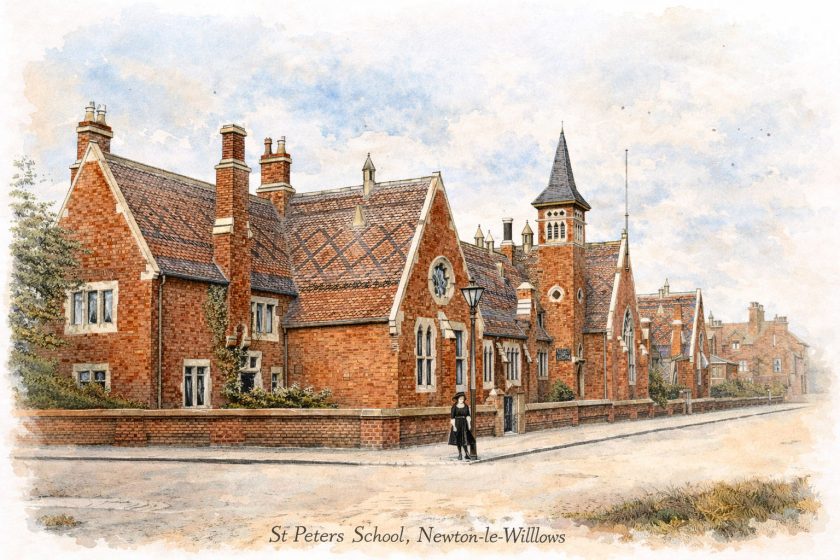
One hundred years ago the then handsome building of St. Peter’s Day Schools was erected. During this century children have been educated within its walls, before setting out on their chosen walks of life. Behind this statement there is a full and interesting story, which itself is only one of the strands in the pattern of education in the township of Newton. The earliest school on record is that started by John Stirrup in 1677, near to the Dean Dam. How long this functioned is not known, for in 1699 one Peter Legh, began a Free Grammar School in the village of Newton. For over one hundred years this appears to have been the only educational establishment in the district.
The industrial revolution of the eighteenth century, by creating factories and towns, produced numerous problems which had to be solved. Education was only one problem, but in the solution of its many difficulties, many educational institutions were created and ideas formulated. In the nineteenth century the full effects were felt, and schools were started in many places by individuals, societies, churches and companies. Such philanthropy is exemplified by the Vulcan Infants School built in 1839. The Wargrave Schools were built in 1845, two years after the erection of the Parish Church of Emmanuel, Wargrave. At Earlestown, the District Infants School was built in 1857 with the help and encouragement of private individuals and the London and North Western Railway Company.
Meanwhile, five years earlier at Newton, a Mechanics Institute was established, to provide facilities “for the moral and intellectual improvement of the inhabitants of the town and neighbourhood, by means of a Library, News Room, Classes, Literary and Scientific Meetings, Lectures and Concerts.” Meetings were first held at McCorquodale’s works, and after 1865 at the Assembly Rooms, now the Old Town Hall. In Newton there was also evidence of private initiative in education, probably because this was the residential centre of the township, graced by the presence of a number of minor gentry. A high class boarding school for girls was conducted at her home by a Mrs. Shearson and later by her daughter Mrs. Barrow. Mrs. Shearson, who died in 1829, is commemorated by a tablet near the organ in St. Peter’s Church. At Ivy Bank, the home of C. K. Clark, Esquire, a Mr. Higginson kept a private school for boys, and his daughter one for girls. In 1837 the Free Grammar School was housed in the old Manor Court House, which stood at the entrance to Willows Park. The Reverend John Sedgewick, curate to the Reverend Peter Legh, incumbent of St. Peter’s, was the Master. In it seventy to one hundred children were taught reading, writing and accounts, without any charge. Later, about 1847, the School moved into the old “Cockpit” and George Armitage became the Master. He remained until the St. Peter’s Day Schools were built in 1860, when he became the first Master.
What of the St. Peter’s Day Schools? Built in 1860, it seems that they entered the educational sphere in Newton rather late. This is not so, for as an educational society they antedate most of the schools mentioned. As in so many towns they were the logical development of the Sunday Schools. The Reverend Peter Legh, son of Colonel Legh of Lyme, established a Sunday School at St. Peter’s in 1823. Over four hundred children received education, a sizeable figure for Newton and district which had a population of about 4,000. What is more, the teachers were paid. Compared with many places, this was an outstanding example of ecclesiastical generosity and the Church of St. Peter’s can justifiably claim to be one of the pioneers of education in the township. This Sunday School met as follows: girls in the Assembly Room, and boys in the old Free Grammar School and later in the Cockpit.
With the success of the Sunday School and the increasing demand for regular and formal education, it became necessary to erect a substantial school building. This was appreciated by the Vicar’s sister, a Miss Mary Legh* who died on 31st March, 1845. This lady, in her Will, dated July 15th, 1844, made provision for a school as the following minute shows:-
National Society,†
Finance Committee, 29th October, 1857.
“The Treasurer informed the Committee that the late Miss Legh of Newton-in-Makerfield had by her will appointed him her residuary Legatee to dispose of her remaining property at his discretion for charitable purposes.
Miss Legh had bequeathed the sum of £800 for the endowment of a School at Newton, but this bequest had lapsed to him as a residuary legatee under the Mortmain Acts, provision having been made for the purchase of a site.”
This money became known as the Mary Legh Bequest. The Treasurer carried out Miss Legh’s wishes and paid £795 to the National Society for the School at Newton. The money was invested and by the following year had increased to £806. By a minute of the General Committee of the National Society of July 7th, 1858 “the Committee agreed to accept Trusteeship of the School Property.”
Because Miss Mary Legh’s Will was dated 1844 it is right to suppose that the idea of a Day School was alive in Newton some sixteen years before the Schools were built. Certainly the main initiative came from the people of Newton who had appointed six Trustees. These gentlemen applied to the National Society for half of the Bequest as an endowment.
* There is a Memorial Tablet to Mary Legh near the organ in St. Peter’s Church.
† The full title was “The National Society for promoting the education of the poor in the principles of the Established Church.” It was founded in 1811.
General Committee, January 12th, 1860. “A memorial signed by the Trustees of this (St. Peter’s) School, was submitted asking that £400, part of the sum invested for the endowment of the School . . . . might be paid over to them towards the cost of building a new School and the Teachers’ Houses. It was agreed to accede to the request.”
From this extract it seems that £400 was used for the building. It may not have been the total sum for one writer has said the buildings cost over £2,000. A sum of about £1,600 was probably subscribed locally, a practice common in Victorian England.
Although the Trustees only asked for the money in January, 1860, they had not been idle. By this date the School must have been partly built. Six months earlier the foundation stone had been laid by Mrs. W. J. Legh. J. M. Lane in his “History of Newton-in-Makerfield” Vol. One, gives an account of the ceremony which is worth reproducing here.
“On August 16th, 1859, the foundation stone of the Schools was laid by Mrs. William John Legh. The school children assembled in church to hear an address by the newly appointed Bishop of St. Helena. Afterwards an adjournment was made to the Assembly Room where a report of the schools was read, and prizes were awarded to some twenty scholars by the Bishop, who spoke a kindly word to each recipient. Number of Scholars in attendance –
Day School: Girls 88, Boys 103
Sunday School: Girls 103, Boys 45
A procession was then formed and proceeded to the site of the new buildings, where the stone was laid in the name of the Holy Trinity, and in the presence of an assembly of 400 children and 300 adults. Mr. McCorquodale, on behalf of the trustees of the schools and the parishioners, then thanked Mrs. Legh for her services and hoped she might be spared to see the schools erected, and that they would receive her kind countenance and support. The Bishop having pronounced the Benediction, the proceedings ended with cheers for Mrs. Legh.”
J. H. Lane also wrote “A year later the schools were completed and a bazaar was held in them, on the 16th and 17th of August, in celebration of the completion and in aid of the funds.”
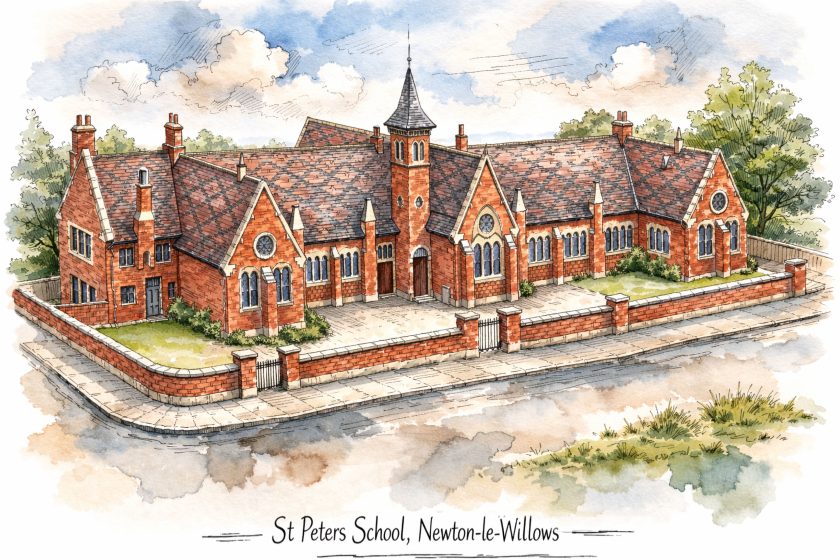
The School building is the same as it was one hundred years ago, except for additional classrooms built in 1914. The architect was Mr. William Poulson, the Town Surveyor and a Warden of St. Peter’s Church. Mr. Thomas Stone was responsible for the Schools’ erection. He was a well known local builder, colliery proprietor and railway contractor. Earlier he had built Railway View in Mercer Street, the Legh Arms Hotel in 1854, the railway houses and the District Infants School at Earlestown, and railway property and part of the station at Crewe. The style is rather peculiar, being called English Geometrical, with steep gables and gothic windows. Built in brick with stone facings, it is typical of its period, and faintly reminiscent of Keble College, Oxford. The attractive appearance of the buildings is enhanced by the bell tower, which is a distinctive feature of the Newton skyline, particularly when viewed from the Mesnes Park. At the base of the tower, the main door is surmounted by the initials of the six original trustees. From left to right they are –
P.L.: Peter Legh, Vicar of St. Peter’s.
W.J.L.: William John Legh, Lord of the Manor, later the first Lord Newton, who gave the School site.
G.M.: George McCorquodale.
M.B.: Meyrick Bankes, owner of Newton Park and Squire of Winstanley.
J.H.B.: Joseph Hornby Birley, a Commissioner of the township.
W.C.: William Caunce.
The above were the original Trustees, but when the Schools began to function, some became Managers. This was due to the Trust Deed which stated that the Trustees were to be “the Minister and Chapel Wardens of the Chapelry District of St. Peter’s, Newton-in-Makerfield.” The control and management of the School, the premises, the endowments, the funds and the appointment of staff were to be “vested in and exercised by a committee consisting of the Minister and five other persons.”
The Trust Deed also tells us what St. Peter’s School was to be used for. It was to be “a school for the education of children and adults or children only of the labouring and manufacturing and other poorer classes in the Ecclesiastical District aforesaid and for no other purpose.” The last phrase restricted the use which could be made of St. Peter’s, a feature which was unusual for this period, when schools were often multi-purpose buildings, housing small libraries, Mechanic’s Institute, Reading and Newspaper Rooms. The restricting clause may have been included, because of the existence of a Mechanics Institute in Newton at that time. St. Peter’s was to be a School only, but because it began as a Sunday School, the connection with the spiritual teaching of the Church was not to be broken. Provision was made as follows: “the principal Officiating Minister for the time being of the said Ecclesiastical District shall have Superintendence of the religious and moral instruction of all the scholars, and may use or direct the premises to be used as a Sunday School, under his exclusive control and management.”
It was in 1823 that the Reverend Peter Legh began his Sunday School. From those early beginnings the desire for education developed in the people of Newton, so that a permanent home was needed for more regular and continuous education. In 1860, the Newton St. Peter’s Day Schools were opened and an idea became a reality.
Chapter Two
The Age of Change and Progress, 1860-1919
The St. Peter’s Schools were built during a period in British history when educational methods and ideas were still in the exploratory stages. Although their roots went as far back as 1823 the Schools were far from being firmly established in 1860, and during their first sixty years they were to experience many strains and stresses, leavened of course, by successes and rewards. Local, national and international events, in their turn, were to make deep impressions upon scholars and staff. The parts of the story are many and varied, an attempt will be made to present these in their true light and context.
The first Master was George Armitage, who had been Master at the Free Grammar School in the old Cockpit. He was helped by his nephew George Armitage Smith. His interest in singing, was reflected in the curriculum, in which singing was important. In 1865 Armitage left the Boys’ School and built a row of four cottages in Rob Lane, “one of which he had fitted up as a school.” There are, however, no records of the first five years of the School except the registers. On October 1865, when the Log Books of the Boys’ School begin, Alfred Smith, a Certified Teacher of the Second Class, took charge as the Master, and Addison Arnold Briggs “commenced acting as a teacher as candidate for Pupil Teacher.” Master Briggs signed his indentures as a Pupil Teacher on July 27th, 1866. Three years later the Briggs family emigrated to Canada where they helped to found St. Peter’s Church, Midlothian. Addison Briggs was a Lay Reader there. On page 2 of the Boys’ Log Book is a reference to an Infants and Girls’ School. Although the Log Book of this does not begin until 21st March, 1870, it was certainly active in 1860. In 1875 the Boys and Girls Schools were amalgamated under the Master to form a Mixed School. The Infants School remained separate.
Under Alfred Smith the Boys School took some time to settle down. In the first few weeks of his Mastership he was busy “ascertaining the qualifications of the boys,” as the Log Books show –
1865. October 3rd. “Arranged Standard Five and issued books accordingly.”
The first task of any schoolmaster at the beginning of the day is to call the register. The early registers of St. Peter’s School show that it complied with the Trust Deed and educated children from Newton and district. Here are the names of some early pupils and their addresses –
1859. Mary Hards, Church Street.
1860. May Ann Fazakerley, High Street.
1860. Catherine Devereux, Railway View (Mercer Street).
1861. Elizabeth Ann Singleton, Wargrave Moss.
1862. Elizabeth Humphrey, Rathbone Street, Earlestown.
1863. Emma Hilton, Golborne.
Attendance was often very low for numerous reasons, as Log Book entries show –
Boys. 1870. February 11th. “Very cold, frosty, snow underfoot, attendance low.”
Mixed. 1887. September 2nd. “Very poor attendance, owing to the heavy downpour – children from a distance not able to come.”
Epidemics were much more frequent than now, and illness often reduced numbers so drastically that the School had to close –
Mixed. 1889. October 14th. “Attendance disastrous, 180 morning, 182 afternoon, owing to the Fever “scare”.”
Infants. 1915. May 21st. “Infants Dept. closed for whooping cough.”
After the register had been called, Fees were collected, for the cost of education in the early days was not borne entirely by the State. The Fees supplemented the grants from the Government. At first the Fees were 4d. for young scholars and 6d. for older ones. In 1891 these were revised and became 2d. for Standards 1 and 2 and 3d. for Standards 3 to 7. Some parents refused to pay and their childrens names were struck off the register. Others were too poor and were admitted to Free Places –
Mixed. 1892. January 13th. “Have this week received applications for “Free Places” from the parents of Thomas Taylor, Arthur Crompton . . . . all of whom in accordance with the instructions of the Managers are now on the Free list.”
Six years later free education was begun.
Mixed. 1898. April 5th. “Dr. J. W. Watkin’s called with leaflets to be distributed to parents and householders offering “Free” Education on and after the 18th.”
When registers had been checked and fees collected, the instruction began. In the early years the large schoolrooms contained the Mixed School, divided into Standards, which could hear each other’s lessons. At times the whole Infant School received a lesson together. Under the Mastership of Alfred Smith the curriculum was extremely vague and not well organised. Moreover, like his predecessor, George Armitage, Mr. Smith was fond of music, being leader of the Church Choir. Consequently, the Boys regularly visited the Girls School for singing, while frequent visits were made to morning service on Saints’ Days –
Boys. 1865. December 8th. “Took boys to early service at Church. Singing with girls P.M.”
Much time was spent in learning Gregorian Canticles in spite of the low standards in the School. However, the Report of the First Inspection expressed hope for a bright future –
Boys. 1866. July 22nd. “This School is doing very well and promises to become one of the best in the district.”
As the Trust Deed stated, religious education was the concern of the Vicar, and he or his curate visited the Schools almost daily, often to give Scripture lessons.
Boys. 1866. October 4th. “Visited by the Rev’d Thos. Whitley who gave a Scripture Lesson to the first and second classes.”
The Government grant to schools was based upon the results of the annual examination and other factors. If an Inspector thought the standards low or that the money could not be used properly, it was withheld or reduced. This was the vicious system of Payment by Results, which prevailed for most of the second half of the nineteenth century. It began in 1866 and ended in 1897. Because of the slackness in the early part of Alfred Smith’s “regnum,” the Government grant for St. Peter’s School was not given. The Inspector’s Report for June, 1867, reads “No grant under the Minute of 20th February, 1867, is payable to the Boys School as Section 162 is not satisfied.” In spite of this set back the boys received a varied education, the subjects including Arithmetic, Poetry, Dictation, Geography and History.
On the 24th December, 1871, Alfred Smith resigned as Master. He went to the Parkside Mill School, Golborne, where he was Master until August, 1906. Mr. John Smalley Foister, a Certified Teacher of the First Class, was his successor; his first Log Book entry reads –
“Examined the Arithmetic in Standards 3, 4, 5 and 6 – found a great want of exactness in the working of the sums.” Mr. Foister intended to raise standards, and later entries record his great efforts in Arithmetic, Drawing and Dictation. He drilled the boys to raise the standards for the examinations. Church visits were reduced and incentives were used e.g. the Hugh McCorquodale Memorial Prizes were awarded each year. The result was that two years later the Inspector could write “The progress which has been made in this School is very satisfactory. The discipline is excellent and generally the instruction is sound and intelligent.” The improvements also meant that the Government grant was obtained and even increased. An Inspector reporting on the Mixed School in 1889 wrote “For both class subjects, payment at the higher rate has, on the whole, been thoroughly well earned.”
The tightening up of standards produced other results, for in October, 1880, “William Parks gained one of the four exhibitions in connection with the Dean Scholarship Charity.” With the efforts of John Foister and later those of James Singleton, the standard of instruction was extremely high, and ambitious schemes were developed –
Mixed. 1889. April 15th. “Commenced taking French as a specific subject in Standards 6 and 7 to be taken in the afternoons . . . .”
In the Infants School object lessons were given on varied and unrelated subjects, such as “Chair, Cart, Horse, Pig, Cow, Ball, Doll, Engine, Bed, Dressing a Doll, Snow and Hail, The Naughty Cats, Bee and Nuts.” The Infants used such equipment as Ball Frames for teaching simple arithmetic.
Infants. 1879. April 18th. “Received from the Secretary a Ball Frame for the School use.”
Building blocks, picture cards and maps were used very much as they are today; reading and writing were begun and recitation was practised –
Infants. 1892. August 15th. “The Babies commenced learning the recitation “Live Pets”.”
Kindergarten methods were introduced towards the end of the century –
Infants. 1888. April 25th. “The School commenced working in the afternoon according to the kindergarten Time Table.”
In the Mixed School, the boys and girls received instruction in arithmetic, reading, dictation and grammar with lessons on “kinds of nouns,” verbs and adjectives. Geography included lessons on the west coast of England and “Geographical definitions.” Generally, lessons must have been rather dull, because most of the writing was done on slates as there were shortages of books and chalk, and until about 1900 many of the classes were drilled severly. The drill which dominated the lessons in the Mixed School was also used in the Infants, where on December 12th, 1888 it was recorded, “The Babies were being taught a new song to accompany the bead threading lesson.” Later they used threaders and pegs in Needlework Drill. In both Schools, lessons appear to have been very repetitive, and boredom must have been widespread among the boys and girls.
The idea of drill also appeared in the Physical Education, which the children received. There is an early reference to this during the Mastership of Alfred Smith when on November 20th, 1865, “Sergeant Nash commenced drilling the boys by classes.” Several years later in 1894 “Sergeant Instructor Wooding began a course of Physical Drill with the boys of Standards 4 to 7.” A few days later Wooding gave Physical Drill lessons to the girls of the same standards.
The Infants also received drill instruction. Equipment used included dumb-bells and rings for boys, and poles, staves or British Banners for girls. The purpose behind the exercises was explained in one Log Book entry.
Infants. 1890. August 22nd. “Exercise One was taken with the “dumb-bells,” the main feature being to strengthen and exercise the wrists.”
Later in November, 1909, “Sergeant Major Wright visited the School to see the children drill. He declared he was properly satisfied.” The school life of infants in Victorian England was full of activity both mental and physical.
Within the building the three original Schools were located as follows: the Transept housed the Infants, West Wing the Boys and the Master’s House, and the East Wing the Girl’s and Mistress’s home. During these first sixty years internal changes took place. The heavy oak desks and benches were replaced about 1900 by dual wooden desks with iron frames. Earlier, mention was made of the various classes and standards being taught in groups within the large schoolrooms. This naturally had its disadvantages, creating distractions, and difficulties in discipline. In 1895, however, this state of affairs was improved by the introduction of new screens, which in the Mixed School “were arranged to divide the schoolroom into three sections.”
In 1910 one Inspector wrote of the Schools, “The buildings are at present quite full. It is understood that a large influx of population is expected in the near future and it will therefore be necessary to consider the provision of further school accommodation in Newton-le-Willows.” In 1914 new classrooms were built.
Although the scholars received a varied instruction, very often it seemed that the teaching was far from satisfactory. This was because of the inadequate training of teachers. The inexpensive system of pupil teachers was practised. By this a good pupil who left school at the age of eleven or twelve could be attached as a monitor to a school. If he or she proved good enough, a five year apprenticeship began as a pupil teacher, at the age of thirteen. An example of this appears at the beginning of this chapter concerning Addison A. Briggs.
It was the duty of the Master or Mistress to give the pupil teachers instruction in teaching, reading, English grammar and literature, music and other subjects. The lesson hours were severe –
Infants. 1897. May 26th. “The Pupil Teachers’ lesson hours have been changed since the Easter vacation from 7-45 to 7 a.m.”
Lessons were criticised by the Master and Mistress –
Infants. 1894. August 17th. “Mary E. Gibbon gave a special lesson on “Linen” to Class I. The subject matter was good but the teacher made a mistake in expecting answers from the children before she had imparted the subject matter to them.” Masters and Mistresses, therefore, had the responsibility not only of teaching their pupils, but also of supervising their assistants. Little wonder some had to take a rest –
Infants. 1905. March 31st. “The Principal Teacher proposes to be absent from 3rd April for a month being advised to take a rest by the Doctor.”
After five years apprenticeship the Pupil Teachers took the Queen’s Scholarship Examination.
Mixed. 1898. March 24th. “J. E. Benison . . . . received notification of the result of the Queen’s Scholarship Examination, being placed No. 86 in the First Class.”
On the results of this examination some were awarded exhibitions valued at £20 or £25 for fees at a Training College. In September, 1898, “Sarah May Baybutt left St. Peter’s Infants School and entered Warrington Training College.” The pupil teacher system gradually died away before the greater and later teachers were trained. One of the first at St. Peter’s was our late Lay Reader, Mr. Collinge –
Mixed. 1898. August 8th. “Mr. Giles Collinge (Chester College) began duty here.”
On the 3rd July, 1905, the Headmaster was recorded as Joseph Arthur Gee, Trained Certificate, Inter B.Sc. London. By this time the School was in good hands.
Yet in spite of the gradual improvement in the quality of the teachers, in the early years it was difficult to control the children, particularly in the Mixed School, where the older boys caused trouble. An example can be quoted.
Mixed. 1877. December 3rd. “On Friday at noon the Reverend Mr. Ward, principal of the private school called and complained about our boys annoying him by throwing stones at his boys and premises . . . . Before leaving, Mr. Ward intimated that he would procure a summons against H. Squire” (Squire was one of the pupils of St. Peter’s).
Attendance was often low because of attractions outside School. These included Racing and Coursing at Haydock Park, visiting circuses, Election Days, military reviews, May Queening, employment at the Post Office where boys could earn six shillings in three days, and Newton Horse Fair. Often during the latter and Race Week, the Schools had to be closed because of the low numbers present. To encourage large and regular numbers, good attendance trips were organised including one to New Brighton in 1895. There were, of course, a number of official attractions which must have relieved the monotony, both for pupils and teachers. They included Choral Festivals at Warrington and Chester, the Consecration of the Chancel of St. Peter’s Church on September 29th, 1893, a “Ghost” entertainment in 1866, a wedding in the McCorquodale family, and a Magic Lantern entertainment. Also the national feeling aroused by the Boer War, led to half holidays for the Relief of Mafeking and Ladysmith.
The end of the Boer War produced a great flush of patriotism in the United Kingdom for this country then possessed the biggest Empire in the world, on which the sun never set. The patriotism of the country was felt in the schools where Empire Day was celebrated with special lessons on patriotism, with drilling and other ceremonial. A good example appears in the Log Books of the Mixed School for Friday, May 24th, 1912. “Observed Empire Day. Lessons given suitable. 11 to 12 noon – a musical tribute paid in the yard. Patriotic songs sung by each class in turn and collectively. Boys marched past Flag and saluted. Girls, standards 6 and 7 each recited an Empire Battle Cry. God Save the King and Cheers in conclusion.” Similar celebrations were enjoyed by the Infants who brought red, white and blue flowers, and sang songs. National pride was also stirred by the loss of Robert Falcon Scott, on his return from the South Pole.
Mixed. 1913. February 12th. “Teachers took the opportunity of attempting to inculcate Patriotism consequent upon the news of Captain Scott’s death in the South Polar Region’s.”
Such was the spirit abroad in our land before the Great War, which was to test this patriotism to the utmost. At the outbreak of the War, the Schools sang patriotic songs, and then plunged into a period of activity to help the war effort.
Mixed. 1915. May 21st. “Eggs presented by children (144) sent to Winwick Military Hospital for wounded soldiers from the Dardanelles.”
During the St. Helens Tank Week £405 was collected from various sources.
It seems, however, that the teachers made the greatest efforts and sacrifices. Mr. McDiarmid was killed in 1916 and two years later the Headmaster, Mr. Gee, was called up. Mr. Waterhouse joined the Royal Garrison Artillery in 1914, and left Standard 4 without a teacher. School life was also broken up by teachers being used for other work –
Mixed. 1916. February 18th. “Miss Jones was sent by Head Teacher to Earlestown Town Hall, to assist with recruiting work.”
Others helped at various times to issue Meat Cards and Ration Books. Great sacrifices were made by former pupils and staff, recorded for all time on the War Memorial Tablet unveiled in 1920. Towards the end of the War, with victory in sight, honour and glory descended upon St. Peter’s School –
Mixed. 1919. February 3rd. “News arrived some short time since that an old boy, Norman Harvey, had won the Victoria Cross.” This was for bravery and devotion to duty near Ingoyghen on October 25th, 1918.
Soon after, in June, 1919, peace celebrations ended the first fifty nine years of the School’s life. It had been a period of great changes and momentous events, beginning in the reign of Victoria and ending in that of George V. The Schools could look back to a period of growth and consolidation, marked by setbacks but brightened by moments of success.
Chapter Three
The Modern Period, 1920-1960
The past forty years of the story of the St. Peter’s Schools are not so well stocked with events and changes as the previous sixty. Looking back, the Schools are seen to have settled down to a period of steady teaching, enlivened by visits and other organised entertainments of an educational nature. It was a happy period, although it began with some hardship. The economic life of the country was slowed down by lack of work, and many industries were depressed. Three extracts illustrate how both Schools had to cope with this.
Mixed. 1921. April 29th. “Tried to ascertain how many children were likely to require “Free Meals” in near future – local Stoppage.”
May 6th. “Numbers of free meal children increasing.”
Infants. 1921. May 6th. “Given food tickets to those children whose fathers are “Out of Work” or “On Short Time”.”
By 1920, a regular pattern of education had been established in most schools, and this in many ways was the same as it is today, although methods of teaching have changed. Fees had been abolished and education was free and compulsory. Drill gradually faded from physical exercise and great emphasis was laid upon free movement. Organised games became more evident with football teams and the like. Brighter and better balanced lessons were due to the presence of properly trained teachers, and the increasing use of modern educational aids such as gramophone records and radio programmes in the inter war years, with film-strips and films since 1945. Yet with all these aids it is the spirit of the teachers which counts, and this has contributed a great deal to the continuing success of the Schools.
Official excursions were still organised; for example in 1924 the senior scholars and staff of both Schools visited the Wembley Exhibition on June 2nd. The Mixed School again visited London in 1937. In recent years there have been other trips – the Annual Outing to Ringway Airport, Lyme Park and Buxton in 1951. This is a continuation of the Annual Treat first began in the 1870’s. Also in 1951, the Schools contributed to the Cavalcade of Newton, which celebrated the Festival of Britain.
From the Log Books it is obvious that the discipline of the Schools became easier in this modern period. This may be attributed to various factors. Parental encouragement was important, because parents were themselves better educated than before. There were fewer distractions in Newton, for the Horse Fair was no longer held, and the Race Days at Haydock Park ceased to be a centre of schoolboy employment. Moreover, the lessons were undoubtedly more attractive, and there was less desire to play truant. The smooth running of the Schools can be attributed to the capable and enlightened leadership of two Headmasters, who have served the Schools faithfully since 1920. Mr. J. A. Gee was appointed in 1905 and served until July 16th, 1936. One result of his successful Headmastership was recorded in the year of his retirement, when an old scholar, Brian Williams, won an Exhibition to Brasenose College, Oxford.
Mr. Gee’s successor was the present Headmaster, Mr. E. E. Mason, who on August 17th, 1936, took charge of the Mixed School. Mr. Mason carefully steered the School through the troubled waters of the Second World War, when the School again made great efforts to bring victory nearer. Money was collected during the various Savings Weeks, an example being £178 in War Weapons Week 1941. The War brought restrictions in time, for in the early years, only half time attendance was allowed. School hours were 9 a.m. to 12 noon and 1-15 p.m. to 3-15 p.m. Other restrictions were the Gas Mask training and testing, and air raids during school hours, particularly in 1940. One legacy of the war period, the School Dinners, is still part of the School’s life. The dinners were begun on December 15th, 1941. Yet all the privations and upsets seemed worthwhile when victory was declared.
The last major change in the organisation of St. Peter’s Schools took place during Mr. Mason’s Mastership. It was the transfer of the senior classes to the Secondary Modern School at Earlestown, and the amalgamation of the Infants and Juniors into one School under one Headmaster. This event occurred on December 1st, 1943, prior to the Education Act of 1944.
Challenge and Change is an apt title for the story of St. Peter’s School, which has stood for one hundred years. It is noteworthy that this century of events began as it ends and is celebrated in the reign of a Queen. Many and momentous have been the events of the six reigns forming the pillars of its history, which although pitted with frustrations and disappointments, are crowned with success and happiness in 1960. May the pupils of today and of the future inherit the fine qualities of their predecessors and prove themselves not unworthy of their historic school.
Lockie Press Ltd., Golborne.
This transcription, its errors, spelling mistakes, format, omission’s and images are copyright © 2026 Steven Dowd, and is provided here for use only on the Newton-le-willows.com website.