A True and Exact Relation of the Death of Friar. Edmund Arrowsmith, a Priest of the Society of Jesus.
When God, who is wonderful in his Saints, manifests their Glory by wonderful Works of his almighty Hand, at the same time that he declares their Merit, he recommends their Virtues to our Imitation. To be silent, after God has spoke the Worth of his Saints by Miracles, appears ungrateful; not to join with the Voice of Heaven in publishing their Sanctity, betrays a Disregard to the extraordinary Effects of his infinite Power in their Behalf.
Providence, ever attentive to our Wants, is very visible in this miraculous Cure; and the End proposed is, no doubt, to awake our drooping Faith. The Health miraculously restored to this Child is intended to rouse our languishing Souls from that fatal, but too general, Indifference in the Concern of Salvation: His Cure must be ours, and the Blessings bestowed on his weak Body, as many Calls to excite Fervour, to renew our Protestations of Fealty, to thank, and praise, and invite others to join us in the Praise of our God, who has wrought this Wonder in our Days. To comply with what may be expected from us, on this Occasion, nothing perhaps can be better suited to the Intimation of God’s holy Will by this miraculous Cure, than to raise in the Faithful an Esteem of their Religion, and a Veneration for the deceased Martyr, whose Memory is thus wonderfully revived, by proposing to their Consideration his Faith, Virtue, Resignation, Constancy, Heroick and Christian Courage, when a pleasing Spectacle to God, and his heavenly Court, he fell a Victim, as a Catholick, a Priest and a Jesuit (all Crimes in the Eyes of deluded Men, but precious Merits in the Sight of Heaven) an agreeable Sacrifice to God, of which the sweet Odour ascended to his Mercy-Seat; an illustrious Example to Catholicks, whom he left Heirs of that Faith, which he recommended by his Death, and bequeathed to them in his Blood.
We have little left concerning Friar. Arrowsmith, after what Enquiry could be made, besides what relates to his happy Suffering for the Faith; though perhaps fuller Memoirs are to be found, than what is here presented to the Reader. It has often happened, that of many celebrated Martyrs, whose Acts of Martyrdom have escaped the Injury of Time, very little came recommended to Posterity, more than the Particulars of their Behaviour in the last remarkable Scene of their Lives. But if to live well be the Art to die well, the happy Death of this Servant of God assures us of a virtuous Life, which God of his Mercy terminated with Glory, and, pleased with his Labours, crowned his own Gifts, to which he had faithfully corresponded, with eternal Rewards.
The following Account of Friar. Arrowsmith is taken out of the Relation of his Death printed 1630, More’s History of the English Province, Alegambe or perhaps Alegambe supplied by Southwell, Nadasi’s Annus dierum memorabilium, &c.
Family and Childhood • Early Life and Education • Betrayal and Arrest • Providence and Zeal in Prison • The Penal Laws • The Trial at Lancaster • Arrowsmith’s Defence • The Verdict and Sentence • Imprisonment • Mr. Leigh’s Prison Visits • The Day of Execution • Final Prayers and Martyrdom • The Judge’s Fate • Ambrose Barlow’s Vision • The Horse-stealer’s Conversion • Eulogy • Veneration
Family and Childhood
Edmund Arrowsmith was born at Haydock, Lancashire, England, in 1585, the eldest child of Robert Arrowsmith, a yeoman farmer, who had served in Sir William Stanley’s regiment which fought for Spain in the Low Countries. His mother was Margery Gerard, a member of the Lancashire Gerard family. Among his mother’s relations was the priest John Gerard, who wrote The Diary of an Elizabethan Priest, as well as another martyr, Miles Gerard. He was baptised Brian, but always used his confirmation name of Edmund, after an uncle who trained English priests in France. The family was constantly harassed for its adherence to Roman Catholicism. One of his grandfathers died a confessor in prison. On one occasion, as a child, he was left shivering in his night-clothes by the pursuivants, who carried his parents off to Lancaster jail; he and his three siblings were cared for by neighbours.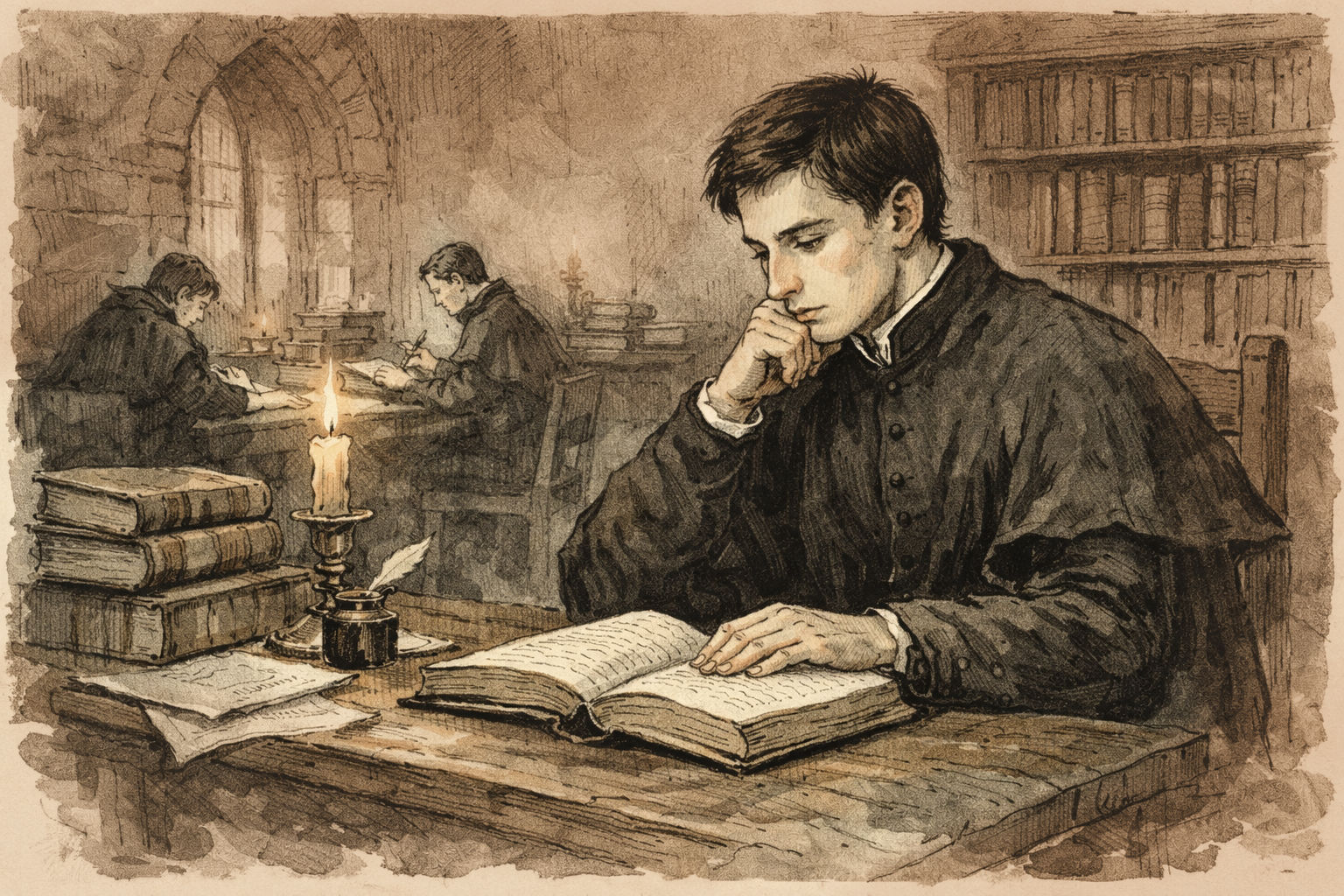
Early Life and Education
In the Year of our Lord God 1628, at the Summer Assizes, held at Lancaster, Friar. Arrowsmith, whose Martyrdom is here to be related, was indicted under the Name of Rigbie, a Disguise, which Persecution and the strict Search after Priests made both just, and necessary in those Days. He was christened Brian, but confirmed Edmund after many great Saints, who had honoured that Name; and chose to be known by the Name of Edmund. Under this Name he revived the Memory of the first Christian Hero of the Society of Jesus in England, whom Persecutors sent from the Place of Execution to Heaven, the famous Edmund Campian, who adorned a pious Life, and many excellent Qualifications with the Palm of Martyrdom. Edmund Arrowsmith was engaged in the same Cause, imitated his Virtues, and his last Act, bravely combating, like the primitive Martyrs, and confirming his Faith with the Loss of his Life. He was born at Lancaster about the Year 1585, and educated at Doway College, a Seminary of many illustrious Martyrs, and zealous Labourers in the Vineyard, learned and pious Persons, who have adorned the Church with their Lives and their learned Works, stock’d Religious Orders with able Subjects, and particularly enriched the Society of Jesus, with many eminent Personages from that Seat of Piety and Learning.
There he was formed by Nature, and Industry with the Help of excellent Masters; and having taken Degrees in Arts, and Divinity, came qualified for the arduous Work of an Apostle, the Salvation of Souls. He had been brought up to Trials; before this last Combat, he had suffered Imprisonment, and given a former Testimony to God and his Church: He entered into a Dispute with the then Bishop of Chester, wherein the learned Champion baffled his Opponent, and eruditely proved the Truth of the Catholic Religion, and the Authority of the Holy See with such Strength and Solidity, that he silenced his Adversary: And behaved with so much Courage and Constancy, that Martyrdom was rather wanting to him, than he to Martyrdom. But God delayed his Combat for the Benefit of many Souls, and preserved him to another Trial, in which he approved himself a true Son of the Church, and a Companion of Jesus in his Sufferings. His Admission into the Society of Jesus, may not improperly be fixed about the Time of his first Imprisonment, since the Accounts of his Life inform us, that it happened a few Years before his Death: For the holy Man lived only five Years in the Society, but Years full of Days consecrated to the Glory of God, the Service of his Neighbour, and his own Sanctification. He had adorned his Station in the Secular Clergy with many Virtues, and was a bright Ornament of that venerable Body; when, resolved to make a full Sacrifice of himself, he determined to reserve nothing to himself, not even his own Will, offering himself up to God by Religious Vows, making Self-denial, which the Perfection of a Religious State requires, a Preparation to his future Martyrdom. His Intention was to conceal his eminent Virtues under the Veil of Humility in Religion, while that of Providence was to give the Society an able Subject, and a great Example in his Person.
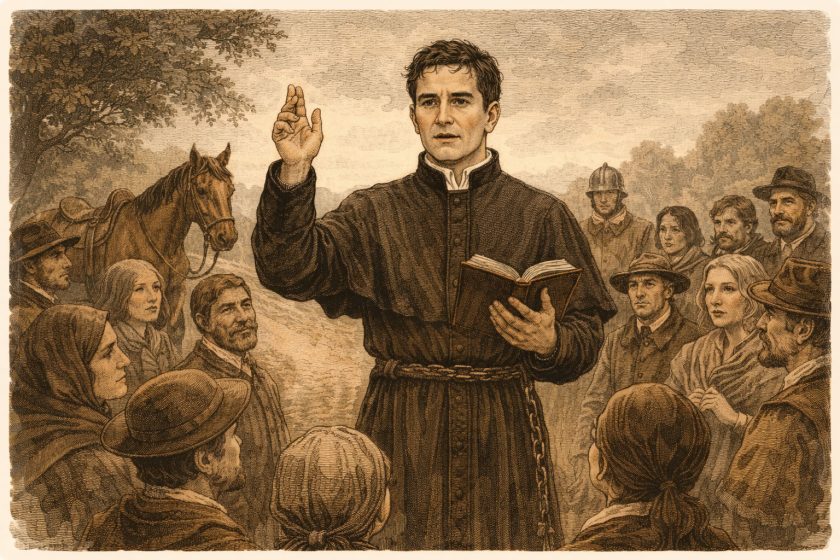
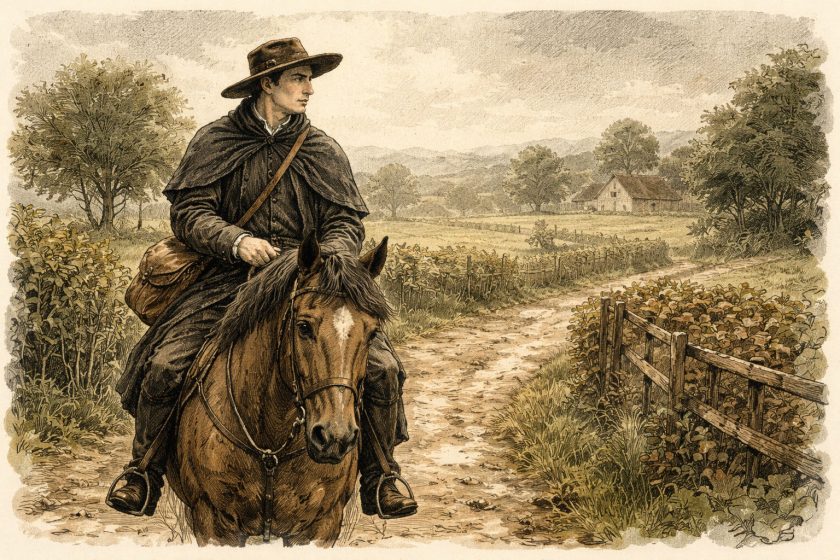
Friar. Arrowsmith was very sensible, that the late Advantages against the Bishop of Chester, and the glorious Victory of the Catholic Cause had raised the Envy, and Malice of many. Worldly Prudence would have suggested a Retreat for a Time, till the Storm was abated; it might even have been pretended a necessary Step for the Preservation of the Flock. But his heroic Soul never knew Fear, and was a Stranger to all Evasions, that are the Offspring of Flesh and Blood. He scorned to desert the Post of Danger, which, though attended with Ignominy and Confusion, he esteemed the Station of Honour, under the Standard of his crucified Lord. No Dangers deterred him, he never spared himself, never yielded to the Toil and Fatigue of the Mission; but with a holy Confidence, and Intrepidity ran all Hazards in Christian Prudence, till, being again betrayed, he was again imprisoned.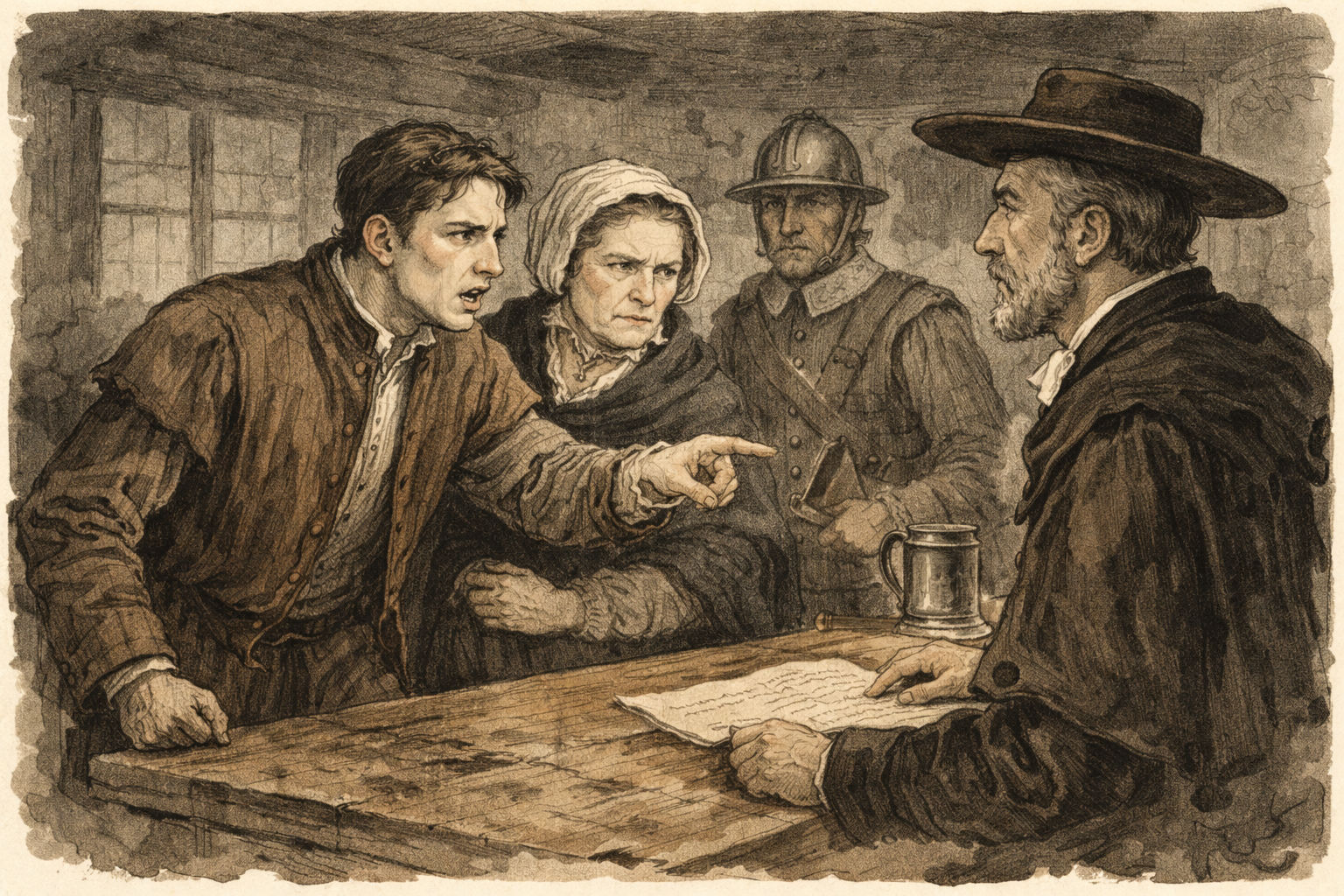
Betrayal and Arrest
A young Man had contracted an incestuous Match with his Cousin, before a Protestant Minister. The zealous Missionary, who performed his Functions in those Parts, often reproved the unhappy Youth, and endeavoured to reduce him to Virtue, from the wicked State, in which he was engaged. A Person obstinately entangled in Sin cannot forgive a Monitor: This raised the Malice of the incestuous young Man, and his Mother; and being acquainted with the Place the holy Man came to, they betrayed him to a Justice of Peace, who instantly gave a Warrant, by which he was apprehended on the Highway. 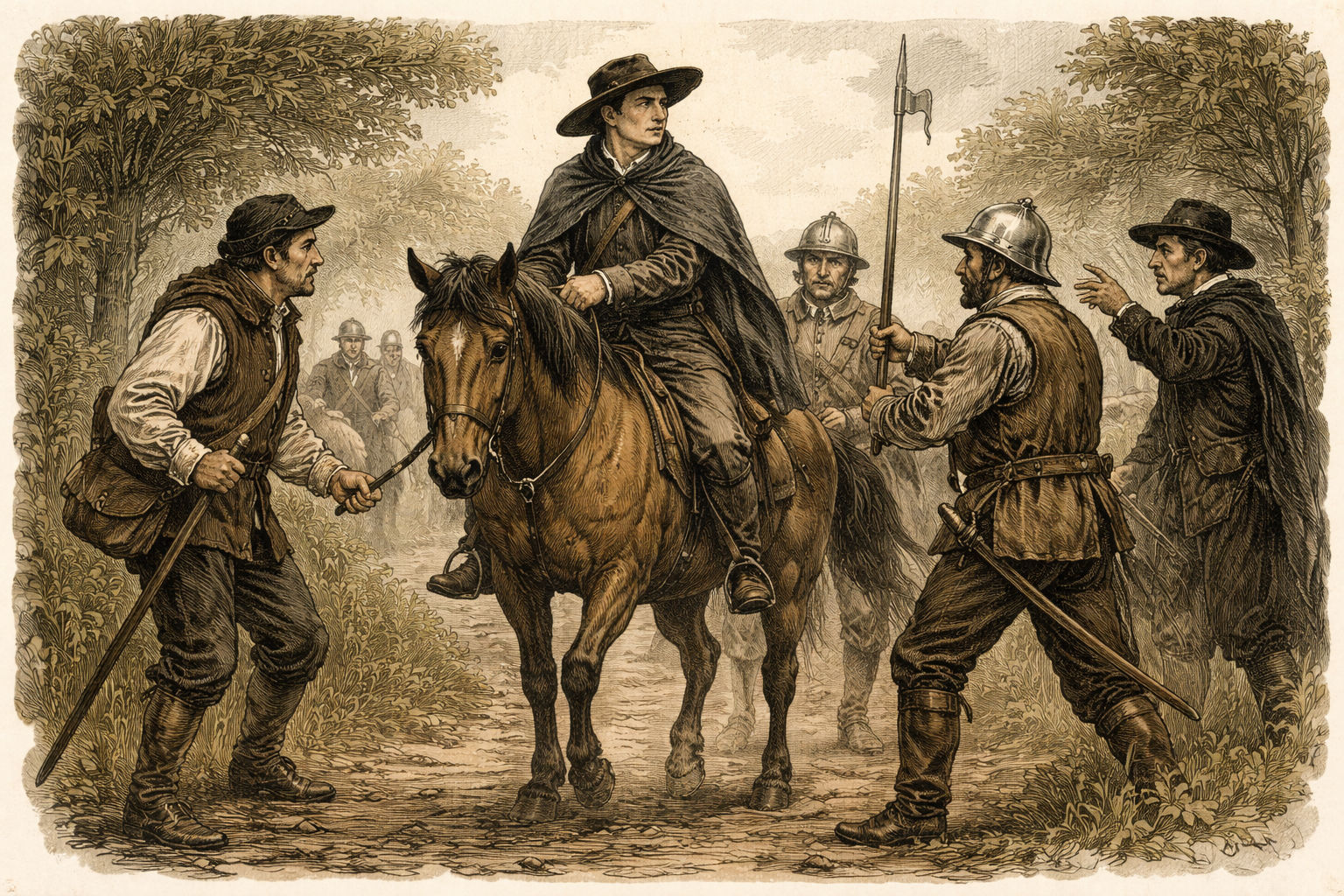
He was committed to the common Gaol for refusing the Oaths of Supremacy and Allegiance, and upon vehement Suspicion that he was a Priest and Jesuit, and consequently by dint of reformed Logic, a notorious Seducer of his Majesty’s Subjects from their Allegiance, and the Religion established in the Kingdom. He was apprehended in Summer, a little before the Assizes, at which he was tried.
Providence and Zeal in Prison
The holy Man, in the first Letter he wrote from his Confinement, observes a singular Conduct of God in this Affair. All Particulars, says he, did so co-operate to my Apprehension and bringing hither, that I can discern more than an ordinary Providence therein. And indeed it appears in every Circumstance. Charles I professed his Abhorrence of shedding Blood on Account of Religion, and had by his Clemency continued steady to that Maxim from his Accession to the Throne. Moreover it was very certain, and since certainly known, that his Majesty did not countenance, nor any Way encourage the Proceedings of his Judge. And when Friar. Arrowsmith was apprehended, though he was very well mounted, all his Endeavours to put his Horse to any Speed proved ineffectual. Besides he was attended by a Kinsman of his, who followed him as a Servant, an able strong-bodied Man, who by the least Resistance could have preserved him and favoured his Escape. For a further Instance of his being reserved for this glorious Combat, he was twice during his Studies at Doway brought to Death’s Door, and twice received the last Unction in that Extremity, but was providentially recovered for this happy End.
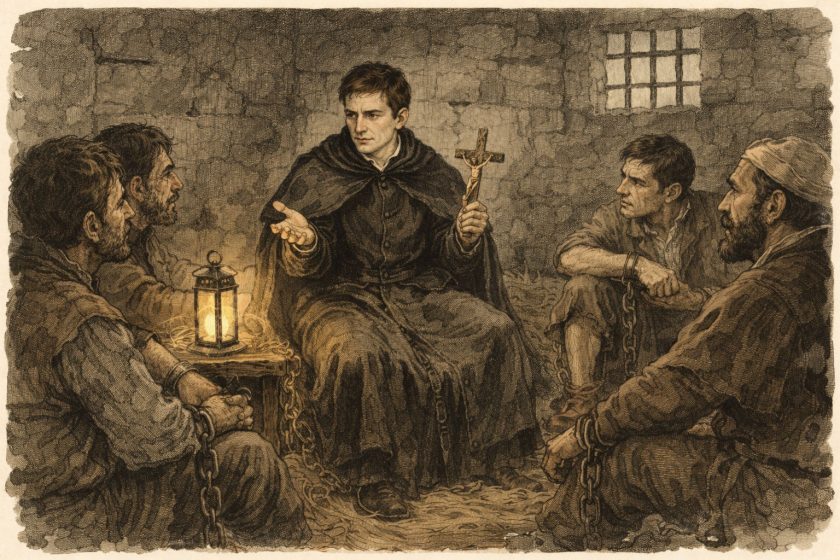
The holy Missionary’s Body was confined, his Zeal could not. He that had been indefatigable in his Duty, gave himself no Rest in Gaol: His Charity and Zeal of Souls continued with him, he exhorted the Prisoners to their Duty, and his Words had such Power and Efficacy, that he engaged the Felons and made them his Friends. He preached the Gospel with Success, and converted one, who followed him in his Death, had a Share in his Glory, was a Jewel in his Triumphal Crown, or rather, to speak with the Apostle to the Philippians iv. 1, was his Joy and his Crown.
The Penal Laws
Some Time before these Assizes, an Order came out for the strict Execution of the Penal Laws, some of which bear Date from the Time that Henry VIII made a Sacrifice of Conscience to Rapine, Lust, and Sacrilege. According to the Temper of the Administration, these Laws were either winked at, or observed in Rigour. Charles I had very little of a peaceable Reign; before the great Troubles, the Party, which at length overthrew that unhappy Monarch, and had been uneasy in his Royal Father’s Time, began to grumble. Whether they were jealous of his Marriage, to a Catholick Princess, or whatever gave Occasion to this Resolution, ’tis however certain, that this Compliment was paid to her Majesty; and the Severity of the Penal Laws was insisted upon; and both before, and since it has often happened, when Parties have contended.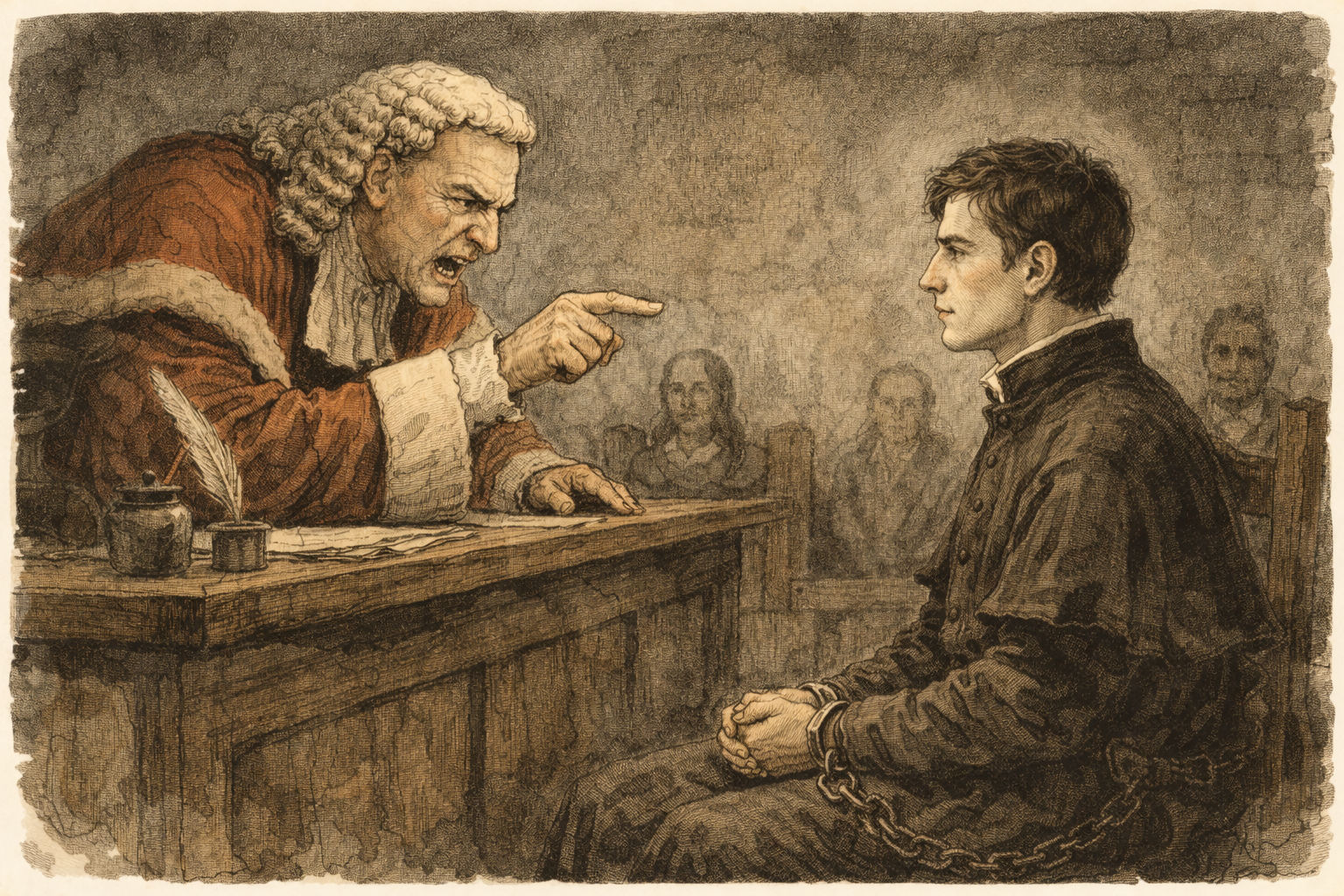
The Trial at Lancaster
This Order gave a favourable Occasion of being Cruel, out of Respect to the Laws, to one of the Judges for the Northern Circuit, a Puritan, and by the natural Bent of that Sect in the Opinion of those Times, more averse to Catholicks. He willingly embraced the Opportunity, and the Day after his Arrival at Lancaster in the Morning, being the twenty sixth of August, he ordered Friar. Arrowsmith to be brought to the Bar. The Prisoner was in Conversation with some Friends, who came to visit him; and the Under-keeper, and the Sheriff’s Men coming to his Chamber, and calling him after a quick and unexpected Manner to appear before the Judge, he cheerfully obeyed, saying, God’s holy Will be done: And was conducted to the Bar amongst Felons, and other Malefactors.
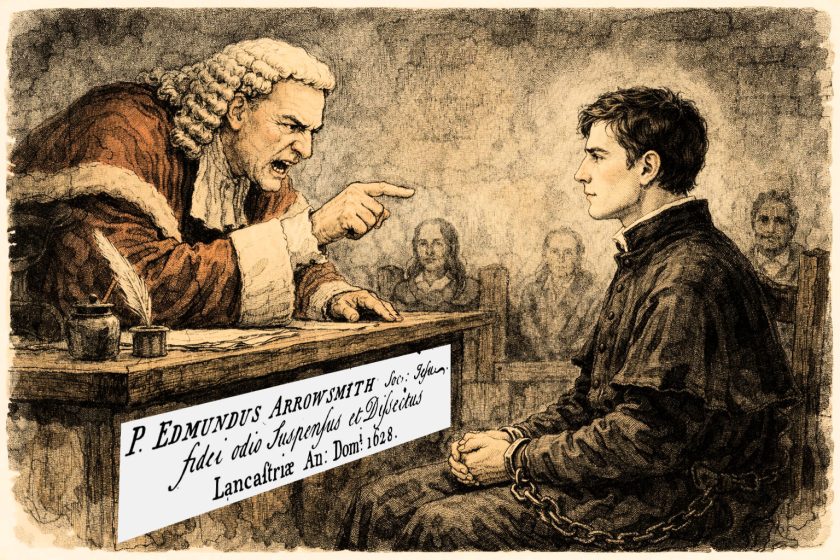
As soon as the Judge, who sat upon Life and Death, saw him, he sent to his Colleague to desire his Assistance in this Service. He soon came, and upon his Arrival they had some private Discourse, when after a short Time, the Jury being called for his Trial, the Judge opened the Proceedings with this rude and ungentleman-like Question. Sirrah, are you a Priest? The Soldier of Christ arming himself with the Sign of his Master, the Sign of the Cross, returned this easy Answer: I would to God I were worthy. The Judge repeated the same captious Question, and he made this second Answer. I would I were. Yes, replied the Judge, he is not, but desires to be a Traitor. After this had been controverted a while, the Judge proceeded from the Affirmative to the Negative, and asked, if he were no Priest; to which the Prisoner was silent; and the Judge, forgetting his Part and Duty of natural Counsel for the Prisoner, to be so much the more an inhuman Accuser, addressing the Jury said; You may easily see he is a Priest. I warrant you he would not for all England deny his Order. Prudence has this Behaviour of not affirming, that they are Priests; not to betray Catholicks, who have harboured them; not to be their own Accusers in Matters that do not concern Faith; and besides, not to depart from the just Right every one has, not to answer an ensnaring Question, where it may be done without any Prejudice to the Interest of Religion; especially since, according to the Course of Law, the Charge is not expected, to be proved from the Prisoner’s Confession, but by Witnesses, till which Time he continues in the Eye of Justice, not Guilty of the Indictment laid against him. Here Mr. Leigh a Clergyman, who acted in a double Capacity, both as Parson, and Justice of Peace, and had some Knowledge of the Priest (perhaps since the famous Encounter with the Bishop of Chester, where Edmund Arrowsmith so gloriously silenced Error) whispered the Judge in the Ear, and shortly after began to revile the Prisoner, declaring him a Seducer, and that, if some Order was not taken with him, he would make half Lancashire Papists. By way of Answer the Prisoner humbly moved, that he might be suffered to defend his Faith in Disputation, which he doubted not, by the Grace of God, to do against any Opponent. The Judge soon put a stop to this Proposal, pretending, that his Doctrine was not to be maintained; but that probably he desired, that those of his Religion should hear him talk. The Prisoner returned this Answer, that he would not only defend it by Words, but would be glad to Seal it with his Blood. The Judge took him up in an outrageous and insulting Tone, you shall, said he, Seal it with your Blood: And, irritated with the generous Liberty of this Champion of Christ, without any Regard to the fair Terms he offered, Swore by all that was Sacred, that he would not leave Lancaster, before the Prisoner was executed, and saw his Bowels burn before his Face. In a furious Manner he often repeated this Threat, You shall die; till the holy Man replied: And you, my Lord, must die: Which was fatally verified in a little more than a Year.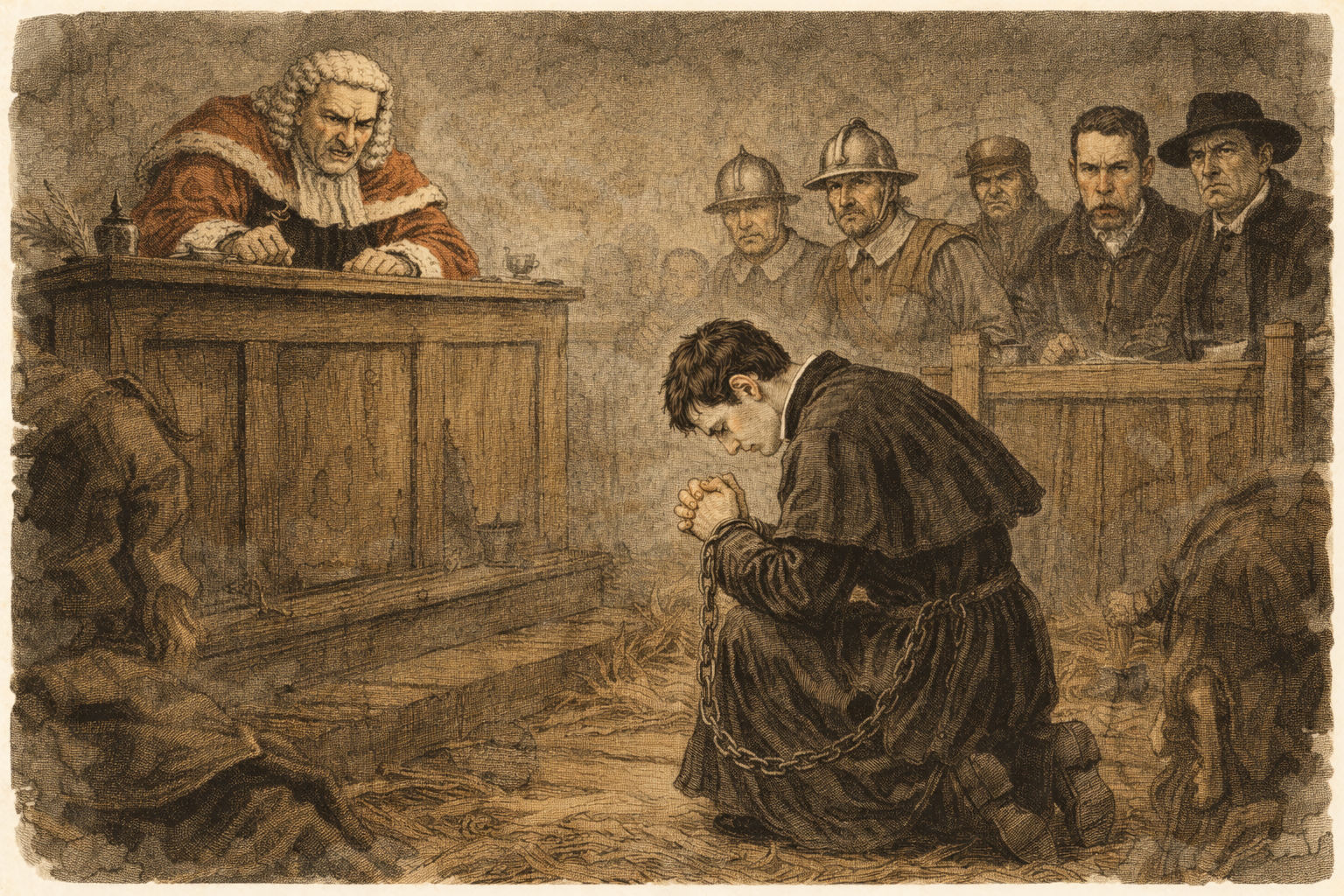
The Judge exasperated, though bent upon ensnaring Questions to condemn the Prisoner, orders him to answer directly how he could justify his going beyond Seas, and taking the Order of Priesthood, in Disobedience to the Laws of the Realm. To this the Prisoner answered; If any Man can lawfully accuse me, I stand ready here to answer him. The Judge made use of these several captious Questions, being very sensible, that there was not sufficient Proof of the Allegations. Different Indictments had been drawn, but none finished, either for want of Matter, or Evidence; at last, by the Judge’s Direction, he was indicted as a Priest, and a Jesuit, upon the Letter of the incestuous young Man, and his Mother, who wrote to the Justice, and as a PERSUADER in Religion. His offering the spotless Sacrifice; his acting as a Minister deputed from God; his being consecrated to him in a particular Manner by Religious Vows; his imitating the Apostles in the Conversion of Souls, were his Crimes, than which nothing can be more honourable. But behold, the Proofs, which, far from evincing what is alleged, only demonstrate the Judge’s inhuman Barbarity. As a Witness, a Servant of the Justice, who committed the Prisoner, was called, and swore, that the Prisoner persuaded him to be a Catholick, and told him, that the Religion now professed in England was Heretical, and only began in Luther’s Time. Then the Justice’s Son about some twelve Years of Age affirmed, though not upon Oath, that the Prisoner would have withdrawn him from Protestantcy.
Arrowsmith’s Defence
The Servant of God hearing this, humbly begged Leave to be heard, which granted, he spoke to this Effect. My Lords, as I was upon the Road, that very Man, as I take it, rushed out upon me by a Hill Side with a drawn Sword: He was meanly dressed, and on Horseback. I made what Haste I could from him, but being weak, and sickly, he forced me at last to the Moss, where I alighted, and fled with all the Speed I was able; though yet that could not be great, seeing I was loaded with heavy Clothes, Books, and other things. At length he came up to me at a Moss Ditch, and struck at me, though I had nothing to defend me, but a little Walking-stick, and a Sword, which I did not draw. With the Blow he cut the Stick close to my Hand, and did me some little Hurt. I then asked him, whether his Design was to take my Purse, and my Life. He answered, that perhaps it was; upon which I fled again from him, but was soon overtaken. Then came this Youth, who has offered to give Evidence against me, and others to assist him. They used me very unworthily, and carried me first to an Ale-House, and searched me to the Skin, offering Indignities, which Modesty forbids to relate, and I resisted as I was able. That done, they fell to drinking; spent nine Shillings of my Money in one Hour; and told me, that the Justice, by whose Warrant I was apprehended, was there in Person; but that I knew not how to believe. Upon this Occasion, my Lords, I began to find Fault with this Man’s wicked and rude Behaviour, who seemed to be the Ringleader; and I besought him for JESUS Sake to give over his disordered Life, drinking, dissolute Talk, and whatever might offend Almighty God. Upon my Word, and upon my Life, this, or to this Effect, is all I said to him. Let him look on me, and gainsay it if he can. As for that Youth, I deny not to have told him, that I hoped when he came to riper Years, he would look better into himself, and become a true Catholick, for that, and that alone would be the Means to save his Soul; to which he made no Answer at all: And, I hope, my Lords, that neither they, nor any other can prove any ill Thing against me.
Whether the Justice, that committed him, apprehended, that his, or his Servant’s barbarous Usage, and rifling the Prisoner, would be animadverted upon him; or whatever his Reason was, he began a bitter Invective, treating him as a dangerous Seducer, and earnestly desired, that no Favour should be shown him; for if ever he got his Liberty, he feared he would do him some Mischief. The Justice’s real, or pretended Fear made the Prisoner smile; and indeed it was not easy to forbear; though Friar. Arrowsmith’s usual Countenance, all agree that knew him, was always cheerful and pleasant. But nothing was to be excused: The Judges, whose Commission includes a kind Regard to the Prisoner, whom they are to protect, as far as Justice allows, reproved him with the unbecoming Appellation of a Saucy Fellow, who knew no better Manners, than to laugh, and flout at those, who sat there in Judgement for the King. How well they represented a Gracious Sovereign, the Reader may judge. The humble Servant of God, the furthest from any such Thoughts, besought them not to harbour that Opinion of him, and immediately kneeling put up his sincere Prayers to God for the King, the honourable Bench, and all the Company, that God of his infinite Mercy would be pleased to confound, and extirpate Heresy, to make us all of one Religion. Here his Judge steps in with his charitable Comment, to explain a devout Prayer into a Curse. Look you, said he, Gentlemen of the Jury, how he wishes God to confound us all, and root out Heresy, by which he means, our Religion. But Charity, had he not been a Stranger to that Virtue, would have informed him, that Catholick Prayers are not directed against Persons, but their Errors. Some may think this candid Behaviour of the holy Prisoner a piece of Weakness and Simplicity, who do not reflect on his Circumstance and the peculiar Influence arraigned Martyrs are under from Heaven. He that encourages and supports them with his Grace in these Trials, has promised them an extraordinary Direction, when speaking to the Apostles, St. Mat. x. 19, he says, When they shall deliver you up, take no Thought, how or what ye shall speak: For at that same Hour shall be given you, what ye shall speak. For it is not you that speak, but the Spirit of your Father, that speaketh in you. In this Point of View, Christians are to consider the Martyrs of Christ, who, in their Conflicts are exalted above themselves, and guided by a Superior Providence in a Work, that exceeds the Strength of Nature.
The Verdict and Sentence
But to return to our Subject: The Judge, upon the slender Evidence we have seen, declaimed against the Prisoner, and endeavoured by malicious Suggestions to banish all Sense of Equity from the Jury, and harden them like himself, against Reason, Justice, and Humanity. He could not, according to the Laws of England, be condemned, for want of Witnesses: But God permitted this crying Injustice, to increase the Martyr’s Merit, and to demonstrate, that his Religion (happy Cause!) was his Guilt. The Jury withdrew, after the barbarous and inhuman Charge, and the Prisoner was remanded to Gaol in expectation of the Verdict. The Jury prepared, and inflamed by the Judge soon agreed of their Verdict, and, the Prisoner coming back, they brought him in Guilty.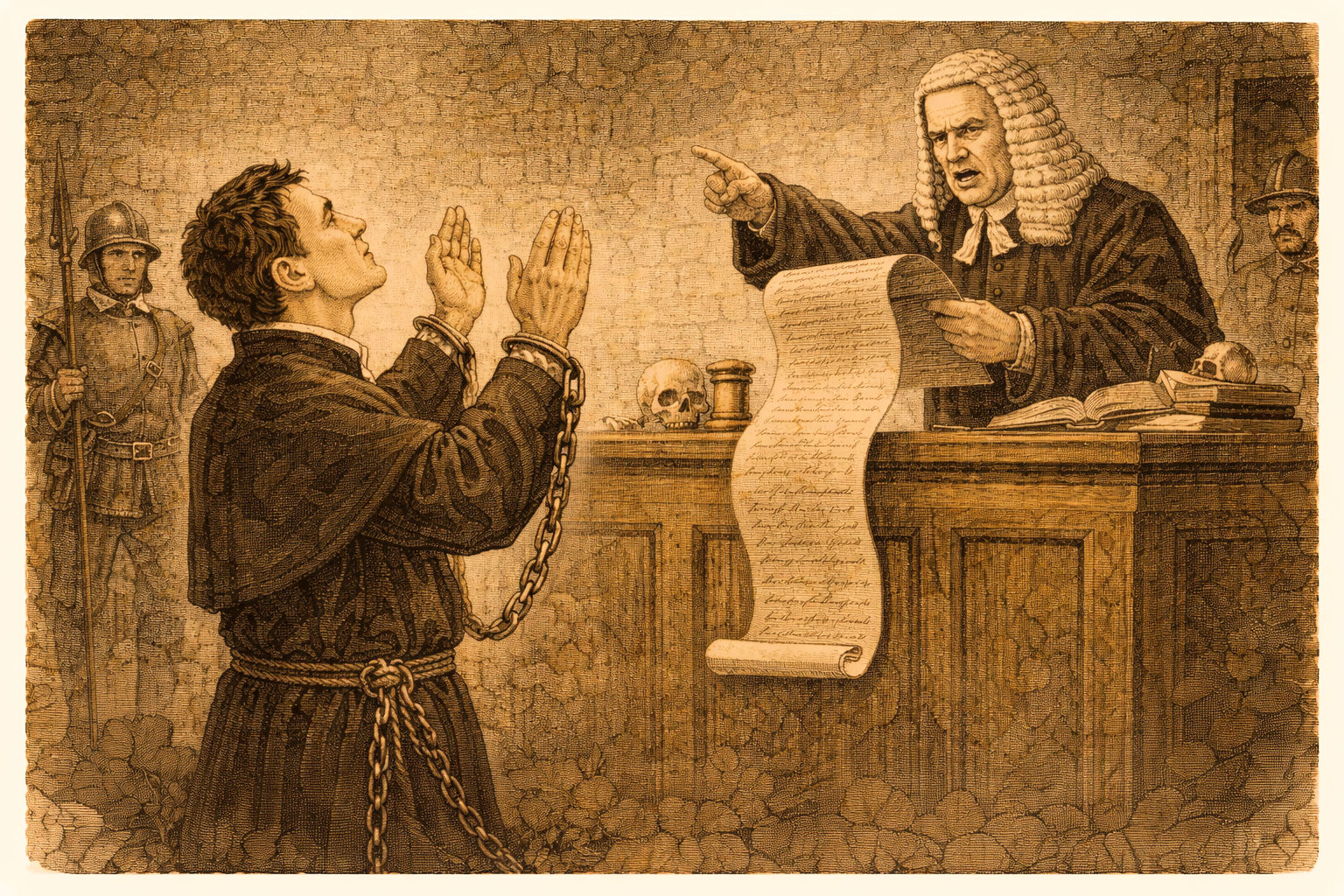
When the Jury had found him Guilty, the Judge stood up, according to Custom, and asked the Prisoner, What he could say for himself, why he should not die according to Law. The Prisoner lifted up, with his Heart, his Eyes and Hands to Heaven, without answering the Question; and in profound Silence and Recollection expected the Event. Then the Judge, whose Colleague was now withdrawn, pronounced Sentence in Words to this Effect: You shall go from hence to the Place from whence you came; from thence you shall be drawn to the Place of Execution upon a Hurdle; you shall there be hanged by the Neck, till you be half dead; your Members shall be cut off before your Face, and thrown into the Fire; where likewise your Bowels shall be burnt; your Head shall be cut off, and set upon a Stake or Pole; and your Quarters shall be set upon the four Corners of the Castle; and so the Lord have Mercy upon you.
Imprisonment
The holy Man, far from being moved with the atrocious Injustice of the Sentence, fell upon his Knees, and bowing his Head very low, adored the favourable Decree of Providence in bestowing upon him this extraordinary Blessing. The Sacrifice he made of himself filled him with unspeakable Joy, so that, unable to master his Transport, he could not contain his pious Aspirations, and pronounced aloud, Deo Gratias, and after in English, God be thanked. The Sentence was to be attended with further Cruelty; the Gaoler conveying the Prisoner back, had Orders by the Sheriff from the Judge to load him with the heaviest Irons. He had been commanded before to put the Servant of God into a Dungeon without Light, and far from Company, but the Gaoler signifying there was no such Place, he was recommended to the worst he had. When he was loaded with those heavy Irons, he was so oppressed with the Weight, that he was rather carried, than walked. In this Conjuncture he recited in an audible Manner the Miserere, one of the Psalms of the Royal Prophet’s Penitence, offering himself to his God, and desiring him in earnest Prayer, with the inspired King, to deal favourably with Sion, that the Walls of Jerusalem be built, that he would fill the Number of his Elect, and receive him into that Number, which are the mystical Stones, wherewith the heavenly City is raised. He then was confined to a little darksome Place, where he could not lie, but was forced to sit with a little Bolster that the Humanity of the Gaoler afforded him to lean upon. The News of his Condemnation struck even Felons and Malefactors with Horror of the Judge’s Cruelty, and Compassion to the Prisoner, whose Virtues, and Innocence could charm a Gaol, but had no Force on a merciless Judge. The confused Noise of their Groans, and Outcries was so great, as to be heard at a very great Distance.
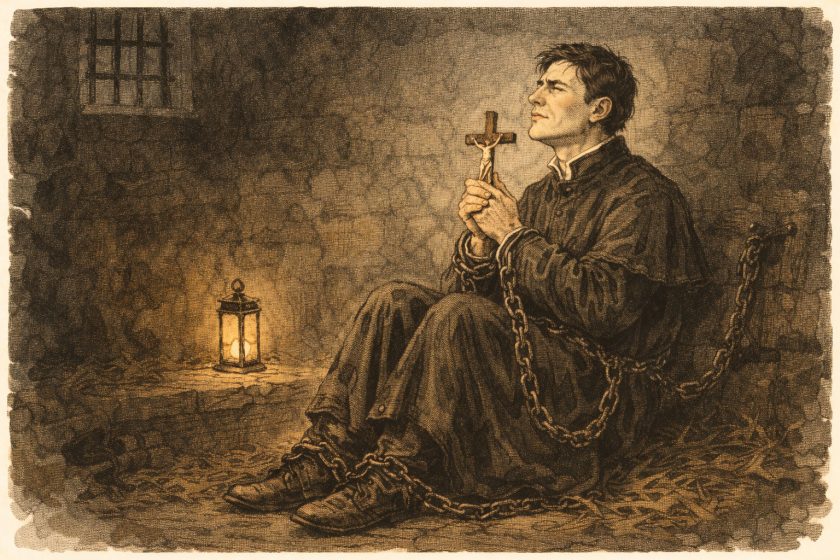
The weight of heavy Bolts oppressed a weak Body, but were no Encumberance to a Soul longing for Eternity. Pious Breathings, fiery and warm Aspirations, a joyful Prospect of the eternal Years, in which he was to be united by everlasting Love and Contemplation to his Creator, took up the short Remains of his Life. He was watched Day and Night, by three or four of the Sheriff’s Men; no one was permitted Access, by severe Orders from the Judge under the Forfeiture of a hundred Pounds. He continued thus from Tuesday about one or two, till Thursday about twelve, with little or no Nourishment, as appeared from the Emptiness of his Bowels at his Execution.
Mr. Leigh’s Prison Visits
A further Order had been given by the Judge to admit no one to the Prisoner, but only as a Hindrance of any Comfort from Friends; for the Justice-Parson Mr. Leigh, so often mentioned, was allowed to visit him in his Shackles; and came to challenge him to a Dispute without Witnesses. The Remembrance of the Victory he obtained in the famous Conference with the Bishop of Chester in the Presence of so many, made him desire a Controversy, without any Company; by this mean Artifice to obliterate Friar. Arrowsmith’s Success; and boast, that he had nonplussed his Adversary the Prisoner. The Wisdom which descended with Joseph into his Confinement, abandoned not our Martyr; he prudently rejected this insincere Proposal of a Person, who, not long before, had falsely reported Advantages, which he never got, in a Dispute with a learned Catholick Gentleman. 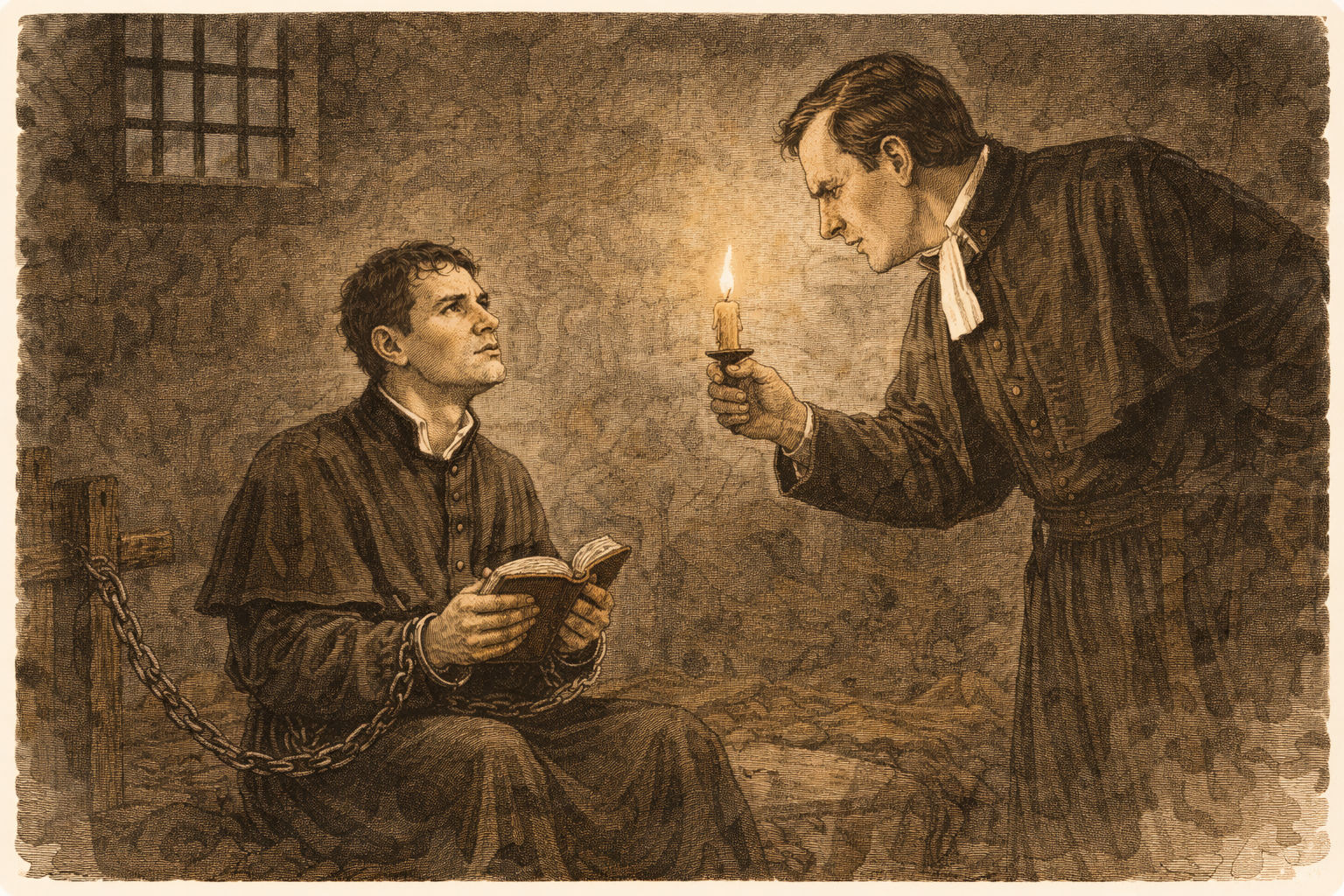
This poor Slight was seen through by Protestants, who observed to him, that if he desired a Dispute, the Prisoner had made a fair Offer in Publick, which had not been accepted; and were with some Indignation offended at this unworthy Proceeding. But Mr. Leigh, and his Adherents thought to wipe off the Aspersion, by representing their Adversary, as a weak Person, who particularly was not conversant in Greek; a vain Evasion, for the Servant of God was known to be a Man of extensive Learning, great Penetration, and solid Judgment, which some of them had found, not many Years before, to their Confusion. Another Visit from the same Gentleman, made towards Night, must not be omitted. Whether Mr. Leigh was, or would be thought afraid, he called aloud for a Candle, not daring to approach him for the Safety, he said, of his Person, lest that Traitor should desperately mischieve him in the Dark. There was indeed great Reason to apprehend such Usage from a Person weighed down with heavy Irons, and scarce able to stir. The Prisoner, a stranger to such Thoughts, spoke with his usual Calmness and Candour, and said: Alas, good Sir, can you think so of me? I would not hurt any of you; and should be glad to spend my Life, to do your Souls good. On the other Side, it was not so easy for Catholicks to speak to the Prisoner: A Catholick Gentleman was seen, by some busy Body, at the Door; upon which he was detained, but soon after called to the Bar; and examined, what Business he had there, he pretended some Excuse, and was dismissed.
The Day of Execution
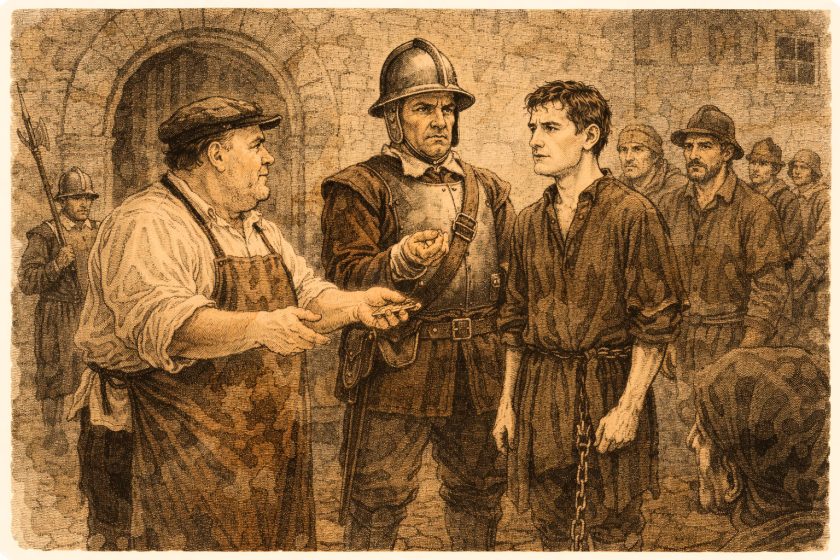
Let us, for a while, leave the holy Prisoner in close Communication with his God, and preparing manfully for his Passage, whilst, attentive to his approaching End, he became the Subject of publick Conversation. It was thought by some, that he would assuredly suffer; and others imagined, that he would be brought to the Place of Execution, and there reprieved. They founded this Opinion upon Charles I his royal Mercy, a gracious Sovereign, who abhorred shedding of Blood, under a Pretext of Religion, and in whose Reign no one had yet suffered on that Account; but they forgot a blood-thirsty Judge, who had Malice enough in his Heart, and Power in his Hand to execute his barbarous Intent. The Behaviour of the Town of Lancaster was very remarkable on this Occasion; to show their Detestation of this Murder, no Man could be prevailed upon to undertake the Execution, except a Butcher, who, though ashamed of doing the Job himself, engaged for five Pounds, that his Servant should dispatch him. His Servant, out of a Sense of Humanity, and Respect to that good Man, when informed of his Master’s shameful Contract, made his Escape from his Master, nor was he ever seen after by him. The Gaol behaved with the same Worth and Integrity: Felons and Malefactors, though to save their own Lives, refused this flagrant Injustice, till a Deserter, under Sentence of Death for leaving his Colours, for forty Shillings, the Prisoner’s Clothes, and his Liberty, offered to be the vile Instrument of this inhuman Murder; and was so detested by the good People of Lancaster, that not one would lend an Axe, to butcher the Servant of God. It is observable that this cruel Wretch, after the base Act, was remanded to Prison, though Liberty had been promised him, where his Fellow Prisoners had him in such Horror, that he was kept out of their Sight, for fear of Violence. Some time after, he was set at Liberty with the Martyr’s Clothes, the infamous Reward of his detestable Service.
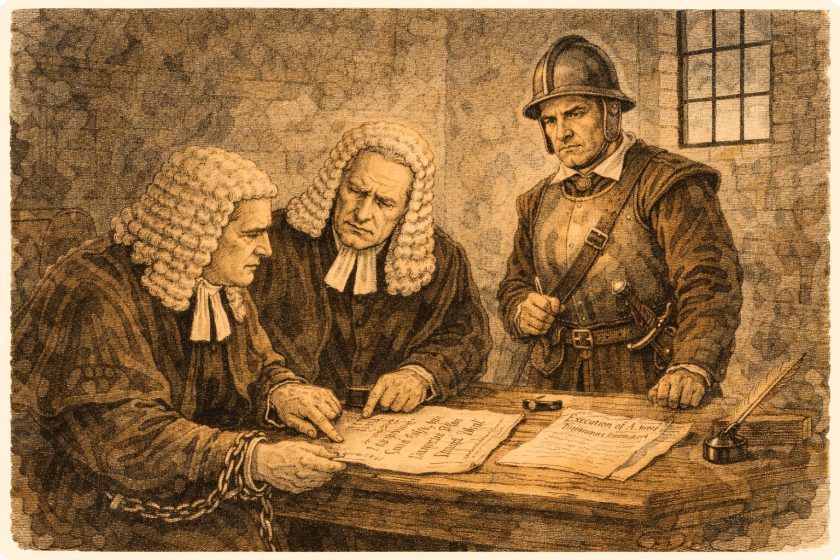
Some Difficulties were found in preparing a Warrant to the Sheriff for his Execution. Illegal proceedings made it hard to draw a proper Warrant. The elder Judge, whom we saw called in to assist his Brother with his Counsel, refused to sign the Warrant; nay, the Judge himself, that had condemned him, would not put his Hand to any Order; the Sheriff would not take the Burden of this Guilt without a proper Warrant; though they all desired his Death: At last a Warrant was drawn up in this illegal Manner, not worded, as usual, “the Judge sitting,” but, “the Court sitting”: And, ordered by the Court. Such were the Irregularities relating to an Order for his Execution; but suitable Directions were given to a proper Officer, to disguise what was amiss. Thus true it is, that the Conscience of the Wicked apprehends even the Testimony of Men, in those very Acts, on which they are eagerly bent. Besides (a Thing not usual at Assizes) by the Judge’s Orders, the Day of Execution was anticipated, to gratify his Eyes with the Sight of his Death.
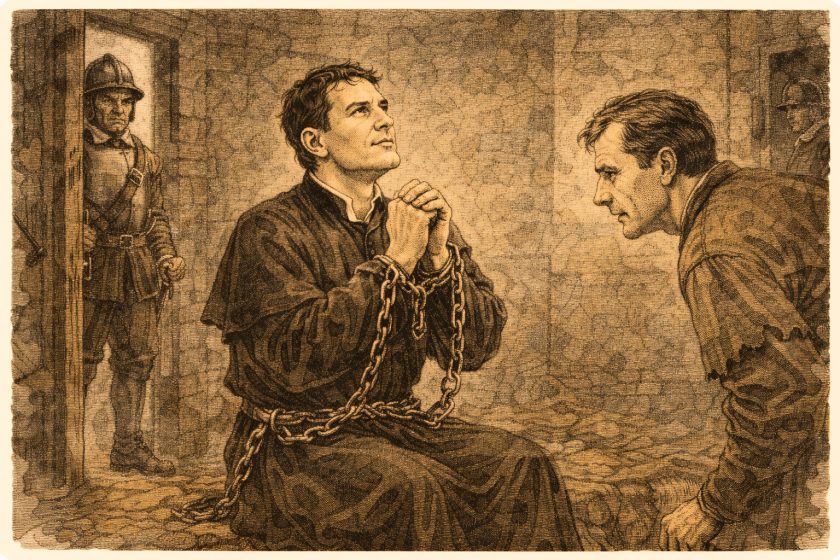
On Thursday, the twenty eighth of August, Word was brought to the happy Man, that he must die within four Hours. He received the News with perfect Resignation; and raising his Heart to God, he said with great Fervour and Devotion, I beseech my Redeemer to make me worthy of it. The Judge, to disappoint the People of so edifying a Spectacle, as the heroick Combat of a valiant Champion, had proposed to have him executed early in the Morning; but the unreadiness of Things necessary for the Execution crossing his Design, he pitched upon Dinner-time, in Hopes that would keep most People at Home. But either the Curiosity of indifferent Persons, or the Hope of Protestants to see him shrink, or the Confidence Catholicks had of his known Virtue and Constancy, unpeopled Lancaster, who crowded from thence, and other Parts, to the Place of Execution; with vast Numbers of all Ages, Sexes and Religions, who waited the last Scene of this Tragedy.
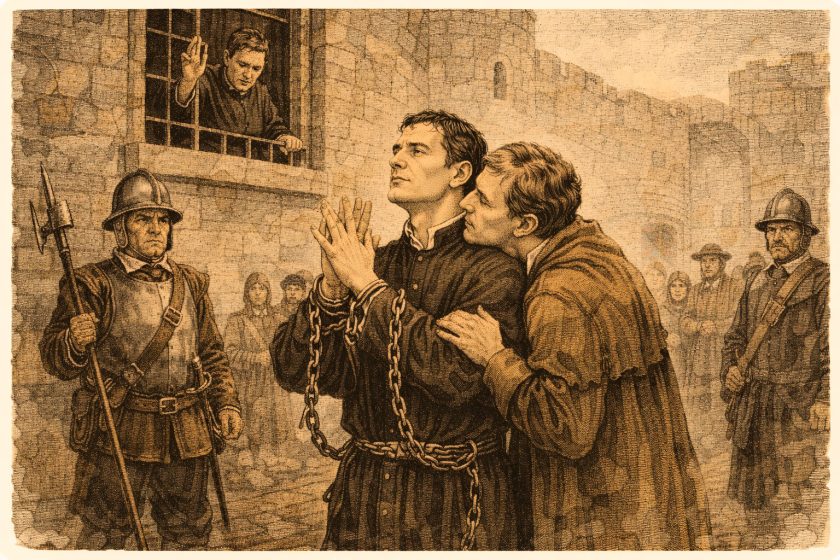
As he was carried through the Castle-Yard a venerable and worthy Priest, his Fellow Prisoner condemned for his Function, but enjoying the Benefit of a Reprieve, showed himself to Friar. Arrowsmith from a large Window: Friar. Arrowsmith, as soon as he perceived him, to beg Absolution, lifted up his Hands (the Sign they mutually had agreed) that dismissed by a Vicar of Jesus Christ, with Comfort from on high, he might endure in the Day of Battle, and triumph in the Conflict. The holy Confessor absolved him in the Sight of the People, and dispatched him, with the Sign of the Redemption, to Conquest, and a Crown of Glory. A Catholick Gentleman, on this Occasion, revived, if not exceeded, the Example of the Great Constantine, who, when he had given Peace to the Church, embraced the maimed Confessors, and kissed the Marks of the Wounds, they had received in the late Persecution. This Gentleman, charmed with the Courage, and Intrepidity of the generous Martyr, marching out to Victory with these Marks of Ignominy and Confusion, discovered, by a clear lighted Faith, under these humbling Circumstances, the true Signs of a Disciple of the Cross, of a Soldier, and Apostle of Jesus Christ: He clasped the holy Man in his Arms, and kissed him tenderly, till the High-Sheriff ordered him to be separated by Force.
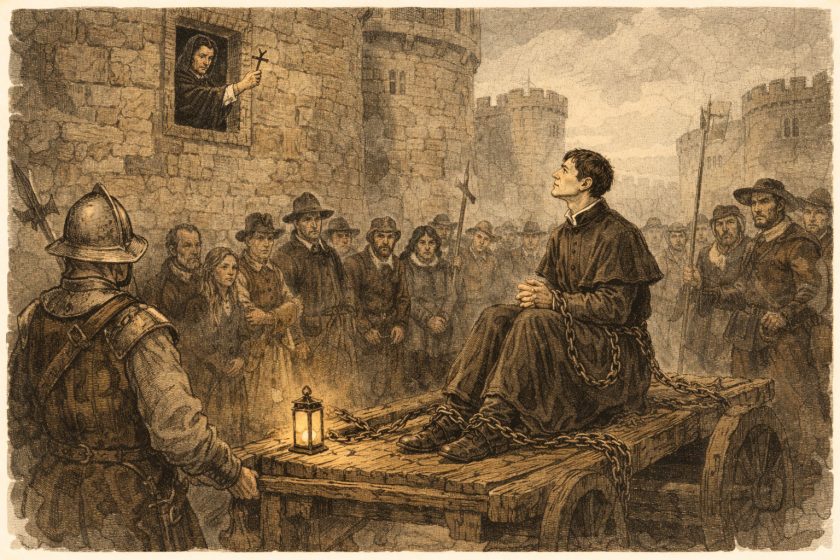
This Gentleman having in this Manner taken Leave of Friar. Arrowsmith at the Castle Gate, the holy Confessor was laid and bound upon the Hurdle, with his Head towards the Horse’s Tail, for greater Ignominy. Thence he was dragged through the Streets to the Gallows above a quarter of a Mile from the Castle, not to be approached by his Friends, who were kept off by the Sheriff’s Men, and their Halbards; but to his greater Torment, some Protestant Clergymen were allowed to molest him. The Executioner preceded immediately the Horse and Hurdle, with a Club in his Hand by way of barbarous Triumph; while the holy Man, bound upon the Hurdle, held two Papers, in which were written down, under the Title of Two Keys to Heaven, an Act of the Love of God, and an Act of Contrition, to move and excite Fervour and Devotion. No doubt, the holy Man’s Thoughts were fixed on his Redeemer going to Mount Calvary, under a heavy Cross, to consummate our Redemption. The Contemplation of his Master sinking under his Cross, and the Weight of our Sins, for which he was immolated, filled him with Transports of Joy and Content, because he was judged worthy of Ignominy for his Name, and admitted to follow the bloody Footsteps of his Saviour.
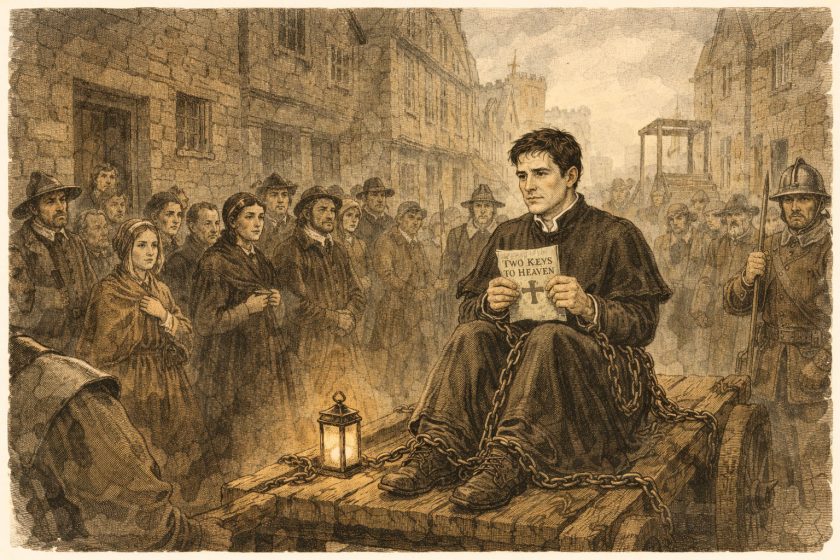
When they came near the Place of Execution, the limping Justice-Parson Mr. Leigh, showed Friar. Arrowsmith a Caldron boiling so high over a vast Fire, that none could abide near, saying: Look you Master Rigbie, what is provided for your Death; will you conform, and lay hold of the King’s Mercy? The blessed Man, with a smiling Countenance, looked at the Tempter, saying: Good Sir, tempt me no more; the Mercy, which I look for, is in Heaven, through the Death, and Passion of my Saviour Jesus Christ; and I most humbly beseech him to make me worthy of this Death. Behold Christian Reader the Altar, and the Victim now ready to fall by the Enemies, and Persecutors of Religion; and adore the immense Goodness of God, who makes use of their Inhumanity, for the Trial of his Martyrs; and wonderfully provides by his Mercy, and prepares by his Grace, in the Persons of Weak Men, pleasing Subjects, to show the greatness of his Power.
Final Prayers and Martyrdom
He was then dragged to the Foot of the Ladder, where being untied, he prayed on his Knees a quarter of an Hour. Full of the Charity which fired the Breast of the Apostle (Rom. viii. 35.) to defy Tribulation, Distress, Hunger, Nakedness, Danger, Persecution, or the Sword, to separate him from the Love of God; and made him, amidst those Things, a Conqueror, through him that loved us. In his Prayer, thrice kneeling down, he thrice repeated the following ardent Oblation of himself. I freely, and willingly offer to Thee, sweetest Jesus, this my Death, in Satisfaction for my Sins; and I wish that this little Blood of mine, may be a Sacrifice for them: Thus he devoted himself a Holocaust to his Jesus. 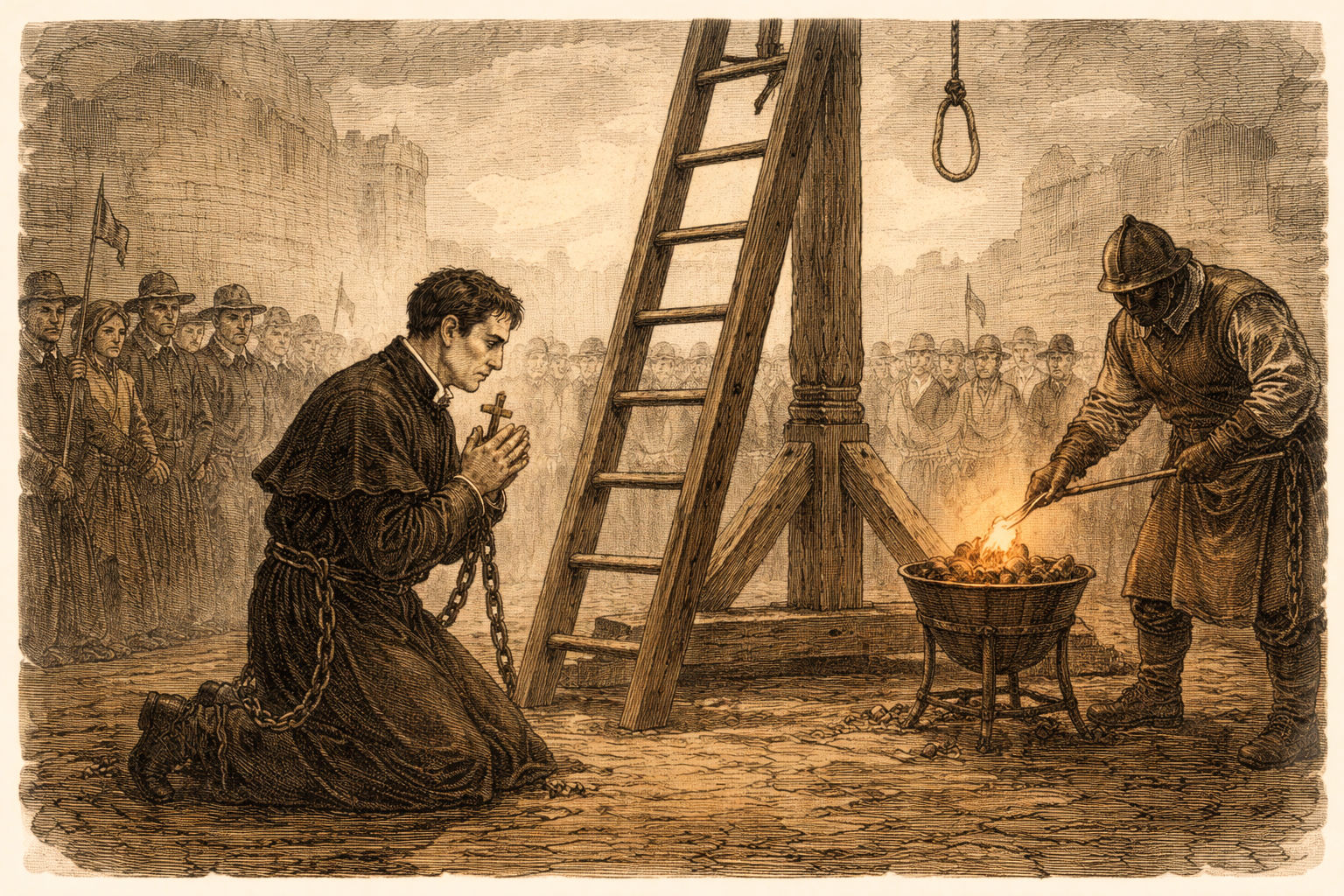
He was here interrupted by some Protestant Clergymen, and charged with Blasphemy; but he that had above put his whole Trust in the Merits of his Saviour, could only be supposed to exclude them by Wranglers. Having with great Patience refuted this Imputation in few Words, he continued to this Effect. O Jesus my Life and my Glory, I cheerfully restore the Life, which I have received from Thee, and, was it not thy Gift, would not be mine to return. I have ever desired, O God of my Soul, to resign my Life to Thee, and for Thee. The Loss of Life for thy Sake, I own my Advantage, and the Preservation of it without Thee, my Ruin. I die for the Love of Thee; for our Holy Faith; for the support of the Authority of thy Vicar on Earth, the Successor of St. Peter, true Head of the Catholick Church, which Thou hast founded and established. My Sins, O Lord, were the Cause of thy Death. In my Death I only desire Thee, who art true Life. Permit not, most merciful Jesus, that I escape Torments to live without Thee. Life can be no Advantage, where Thou art not. Give me, good Jesus, Constancy to the last Moment, let me not live one Instant without Thee; For since Thou art true Life, I cannot live, unless Thou livest in me. When I reflect, that I have offended Thee, I am seized with greater Grief, than can be caused by the Loss of my Life. O Life of my whole Life! but how of my whole Life, if I have ever offended Thee? However, with true Sorrow I wholly devote myself to Thee, and with all my Heart forgive those, who take my Life away, and, by that Means, give me this Opportunity to resign it into thy Sacred Hands. Such were the fervent Aspirations, or rather the Flight of a Soul carried with Rapidity to her Centre, her God, preserved by the Witnesses of his Martyrdom, as precious Remains of a Christian Hero. Frequent Endeavours were made to interrupt him, but his Prayer, like himself, was fixed and immoveable; till ordered by the Sheriff to make haste, he obeyed the Call of Providence, rose up with these Words of Resignation, God’s holy Will be done, kissed the Ladder, and went up with Courage and Resolution.
As he mounted the Ladder, he desired the Catholicks to join their Prayers with him, and for him, to obtain the necessary Graces to support him in this last, and decisive Engagement. Mr. Leigh the Justice-Parson replied very falsely (for many Catholicks came to be edified) that there were none present, but he would pray for him. The blessed Man answered: I neither desire your Prayers, nor will I pray with you. I will have nothing to do with you; and if what you say be true, that there are no Catholicks here, I wish to die as many Deaths, as here are People, on Condition, that they were all Catholicks. With that he prayed for his Majesty, recommended to Almighty God the State of this Kingdom, and in a particular Manner his Persecutors, whom he freely forgave, desiring also Forgiveness of Whomsoever he had offended. Going up a little higher he addressed himself thus to the Spectators. Bear Witness, Gentlemen, who are come to see my End, that I die a constant Roman Catholick; and for Jesus Christ his Sake, let not my Death be a Hindrance to your well doing, and going forward in the Catholick Religion, but rather may it encourage you thereto. For Jesus’s Sake, have a Care of your Souls, than which nothing is more precious; and become Members of the true Church, as you tender your Salvation; for hereafter, that alone will do you good. I beseech you, request my Brethren, for his Sake, who redeemed us all, to be careful to supply my Want and Insufficiency, as I hope they will. Nothing grieves me so much, as this England, which I pray God soon to convert. He then betook himself to a fervent Prayer, which he read out of a Paper, and drew his Cap over his Eyes, expecting to be turned off.
But the limping Tempter Mr. Leigh had not yet done; a further, and last Attempt was made, to shake the holy Man’s Constancy: Pray Sir, said he, accept the King’s Mercy, take the Oath of Allegiance, and your Life shall be granted. Good Sir, accept your Life; I desire you to live: Here is one come from the Judge, to offer you Mercy. You may live, if you will conform to the Protestant Religion. The Servant of God drew his Cap from his Eyes, and with a severe Countenance, and some Resentment of the Injury offered to his Resolution of dying a thousand Deaths, rather than accept such Terms, answered, O Sir, how far am I from that! Tempt me no more. I am a dying Man: I will not do it in no Case, on no Condition. Then, with great Firmness of Mind, he addressed the High-Sheriff, exhorting him, and the rest to take Care of their Souls. The Day will come, said he, when far from repenting your return to the Catholick Church, you will find it your greatest Comfort, and Advantage. He continued in this Strain, till some Protestant Clergymen answered; they would look well enough to themselves; and others of the same Cloth, fearing, that the Words of a dying Hero, would have too great an Influence on many, interrupted him, crying out: No more of that; no more of that; away with him. 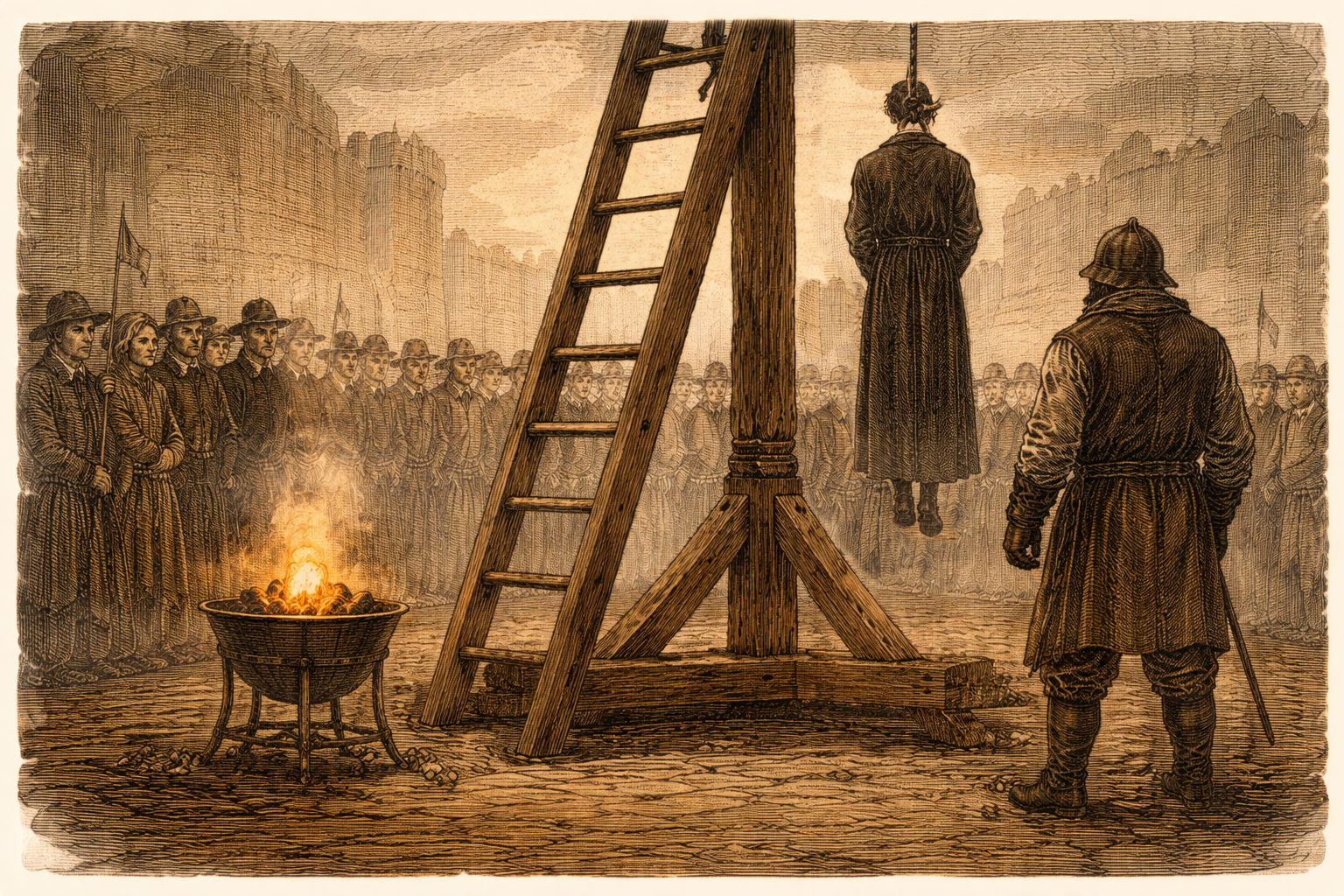
Friar. Arrowsmith now composed himself for his last Act, he again covered his Eyes, and fixed in ardent Prayer, contemplated him with a lively Faith, whom he was immediately to possess for Eternity. His Lips were seen to move, and Bone Jesu, Good Jesus were the last Words, that immediately preceded his being thrown off the Ladder, and suffered to hang, till a happy Soul free from a mortal Body was admitted to the Crown of Justice, which is laid up for faithful Servants, and is in the Language of St. Augustin, by God’s Mercy their Due. The rest of the cruel Sentence was immediately executed; he was cut down, dismembered, bowelled, quartered; his Heart torn out; that and his Privities burnt. His Head was also cut off; the Head, and Quarters were boiled in the Caldron; the Blood with Sand, and Earth scraped up, and cast into the Fire. Lastly, his Head, agreeable to the Sentence, was set upon a Pole, among the Pinnacles of the Castle; and his Quarters hanged on four several Corners thereof.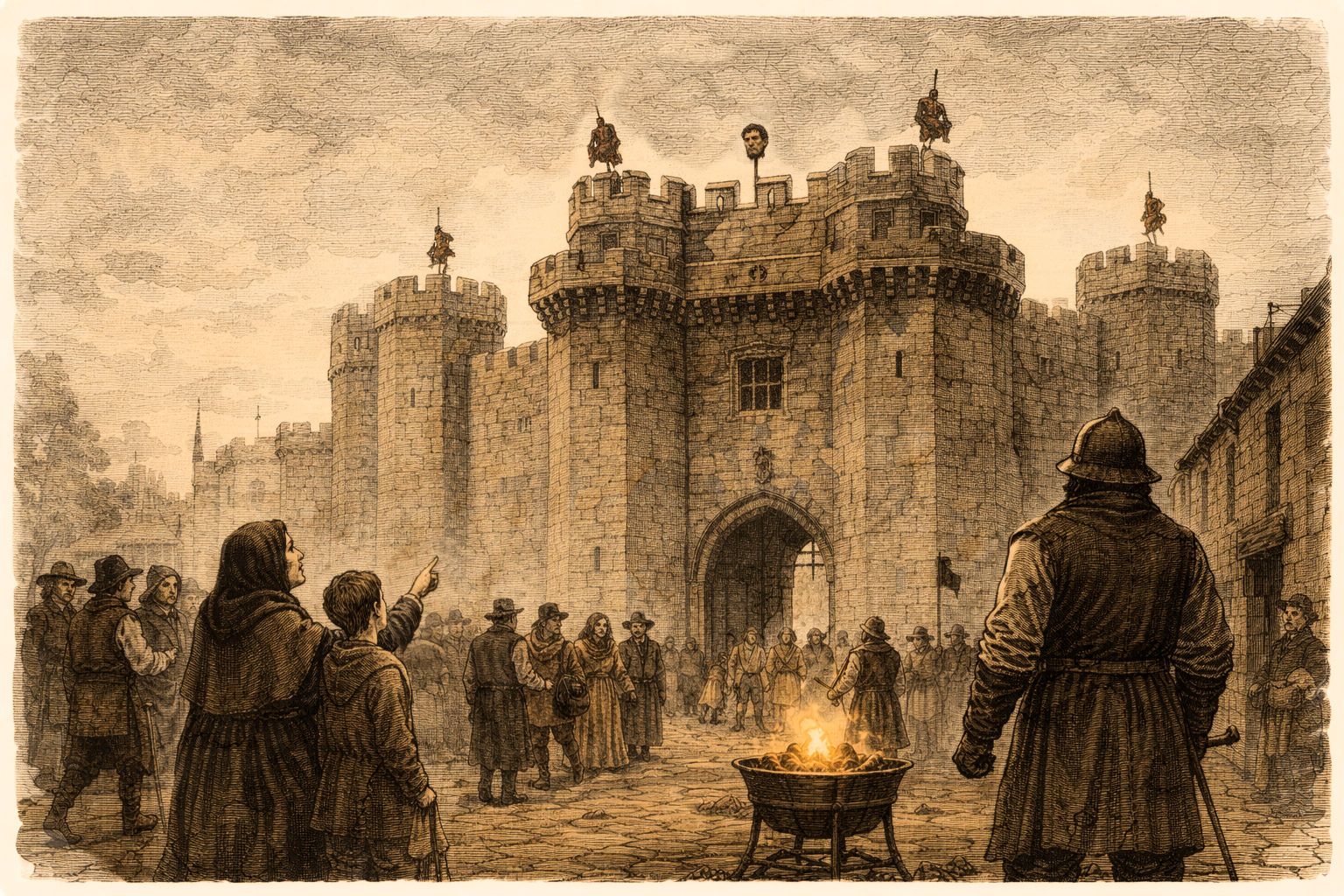
Various were the Affections of the Persons, who assisted at this Tragedy, and beheld his Exit. Many Protestants, moved with his Fortitude and Patience, wished their Souls with his, who then died. Others, either out of Remorse, or Detestation of this bloody Act, repented their coming to this Spectacle. Some judged it very laudable, to be constant to their Religion; but thought it too great a Stretch of Obligation, to die for that Cause. Some, touched with Compassion, esteemed it barbarous, to use a Person thus for his Religion. Mr. Leigh, and some of his Malicious Temper, seemed the only Persons pleased with this Inhumanity. The Catholicks, who in great Numbers had attended this last Scene of his Apostolical Life, were comforted, and confirmed in the Truth of that Religion, which he recommended efficaciously by his Example; they praised God, who, in their Days, had raised Friar. Arrowsmith, and placed before their Eyes this Pattern of Patience, Humility, Constancy, Charity, incessant Zeal of Souls, which shone forth with Lustre in the triumphant Martyr, who was gone before to assist them with his Prayers in the Sight of God, as he had done on Earth by his pious Labours, to the daily Hazard, and at last, to the Loss of his Mortal Life, for the greater Glory of God, and their eternal Benefit.
The Judge’s Fate
The Behaviour of a Sanguinary Judge increased the Martyr’s Glory, and, in that Respect, must be allowed a Place in the Acts of the Martyr. Pleased with the Success of illegal and barbarous Proceedings, he had anticipated the Day of Execution, to see with Satisfaction the Death of Friar. Arrowsmith, whom he had condemned, without any Regard even to the known Laws of civilized Nations. He was ashamed to appear at the Place of Execution; perhaps to indulge his cruel Temper more, in seeing the Butchery at a Distance through a Prospective Glass, without any Constraint from the Spectators, who would justly be surprised at this extraordinary Procedure in an Administrator of Justice. Thus he feasted his Eyes with Blood, having first taken an Oath, not to sit down to Table, till Arrowsmith was dead. Dinner was ordered up in a kind of Triumph, when his Oath was discharged; here he seemed Religious, to be more cruel. After Dinner some Venison came in, a Present to the Judge; while he admired the Venison, Friar. Arrowsmith’s Quarters were brought in, that he might enjoy the bloody Act, of which he was the Author. To glut himself with Horror, he barbarously handled the Quarters of the Deceased, laid them by the Venison, and was not ashamed inhumanly to compare them together. To complete all, the next Day, leaving the Town, he turned his Horse, and making him prance, in a vain-glorious Boast of his Injustice, he looked towards the Martyr’s Head; which he not thinking placed high enough, ordered to be raised six Yards above the Pinnacles of the Castle. Vain and senseless Efforts of impotent Malice! Fruitless Attempts to increase the Ignominy of the Deceased! The Glory of Martyrdom had placed him out of his Reach. If his Head was to be raised to a more eminent Place, it only served to make his Trophies more conspicuous. Divine Justice is not to be avoided without Penance, and Satisfaction: In little more than a Year it overtook the inhuman Judge; for on the twenty third of January 1629-30, the Judge sitting at Supper felt a Blow on his Head, as if some one had struck him with his Fist; upon which he fell in a Passion against the Servant, that waited behind him; but he protesting, that neither he had stricken him, nor seen any one strike, he received a second Blow like the first, and was carried under great Terrors, and Fear to Bed, where the next Morning he was found struggling with Death, and departed, leaving an Example, and a Warning to Judges. Whether these two Blows were to call to his Remembrance the Deaths of Friar. Arrowsmith, and Richard Herst, two innocent Persons, against whom he passed an unjust Sentence, is left here to the dread Judgments of God.
Ambrose Barlow’s Vision
How different a Fate had Friar. Arrowsmith, who, on the Day of his memorable Combat, appeared to the R. F. Dom. Ambrose Barlow of the English Benedictine Congregation, then at a great Distance, and ignorant of what had been transacted at Lancaster; to whom, having communicated his Success, and happy Conflict, he foretold at the same Time, that he was to be blessed with the like glorious End. But let us rather hear the Martyr himself speak of our Martyr; their Language seems best to suit their Exploits. This holy Man was the next, that was executed at Lancaster, on the tenth of September 1641, in the forty fourth Year of his Age; and from his Confinement in Prison he gives this familiar Account of his future Death, and the Prediction of Friar. Arrowsmith; in a Letter to his Brother the R. F. Dom. Rudisind Barlow, then at Doway. I believe (says he) I shall suffer; for Mr. Bradshaw (this was one of the Names, under which Friar. Arrowsmith was concealed) the last that suffered Martyrdom, the Night after he suffered, whereas I knew nothing of his Death, spoke thus to me, standing by my Bed-side: I HAVE SUFFERED, AND NOW YOU WILL BE TO SUFFER: SAY LITTLE, FOR THEY WILL ENDEAVOUR TO TAKE HOLD OF YOUR WORDS. His happy Death verified the Prophecy. R. F. Ambrose Barlow was of the ancient Family of Barlow, of Barlow in the County of Lancaster: he not only was a Martyr, but intitled to suffer for Religion by his Profession, as a Member of the English Benedictine Congregation, famous, from its first Institution for Apostles of divers Nations, illustrious Martyrs, shining Lights of the Church by their eminent Piety and Learning, who have, down to our Times, in their respective Capacities propagated, adorned, and with their Blood defended the Catholick Faith: And also by Inheritance, as descending from a Confessor of Jesus Christ, his Grandfather, who, though he did not suffer a violent Death, died in Confinement for his Religion. This was Alexander Barlow of Barlow, Esq; who in this excellent Cause, was first a Prisoner at Manchester, and afterwards at a Gentleman’s Seat in the same County. A Blessing seems to have attended this last Prison where he died, the Family having embraced the Religion for which he suffered.
The Edification of our Neighbour have obliged me to give a Place in this Narration to this worthy Gentleman and illustrious Confessor, lest, by the Injury of Time, a noble Example of Christian Fortitude, and Patience should be buried in Oblivion.
The Horse-stealer’s Conversion
For the same just Reason we must not wrong the Reader, nor the Zeal of Friar. Arrowsmith, nor Divine Grace of its Influence, by passing under Silence its Effects in the Person of a Horse-stealer happily converted in Gaol by the holy Man. We must join to the Spiritual Father, the happy Son, of whom in his Prison he travelled in Birth, till Christ was formed in him. The Redeemer of the World, who suffered in his persecuted Church, showed the Power of his Grace in those, who co-operated with him to the Salvation of Souls, and triumphed in his Martyrs. They followed his Footsteps; and in their Behaviour, we may trace the Lineaments of the Original. He is their Example; and we know those chosen Vessels, by the Resemblance they bear to the Pattern. He snatched on his Cross the good Thief from Perdition. It is but a Consequence of St. Paul’s Theology (Rom. viii. 19.) if I compare the valiant Soldier Edmund Arrowsmith to his Leader and Sovereign, the King of Martyrs; For whom he (God) foreknew, he also predestinated, to be made conformable to the Image of his Son, that he may be the first begotten among many Brethren. The Servant of God suffering in Prison, and piously emulating the Work of his Saviour, through God’s Grace, brought this Horse-stealer not only to be a Companion of his Faith, but a Partaker in his victorious Palm. The Judge anticipated the Day of Execution, to content his sanguinary Temper; but did not Providence design, that Arrowsmith in his Glory should secure, by his Intercession, the Purchase he had made on Earth, from that Blessed Place, where the holy Martyr Cyprian affirms, the Martyrs are as sollicitous for our Safety, as they are assured of their Felicity? In Effect, Faith had taken so deep a Root in the Heart of the Convert, that no Promises of Life could shake him: His Life was often assured him, but to no Purpose; he was confirmed by the Blood of his Father in Christ, fixed by the Efficacy of his Example, and his Prayers. To be short, like the prudent Merchant Man seeking for good Pearls, who having found one precious Pearl, went and sold all he had, and bought it, this fortunate Horse-stealer preferred the Gift of Faith, without which it is impossible to please God, undervalued his Life; and, in the Sense of the Gospel, sold all he had to secure this Jewel. Wonderful, but adorable Dispensation of Providence, by which the Redeemer in the midst of his Sufferings, of a Thief having made a Saint; by the Person of this Apostolical Man, his Disciple and Imitator, from a Horse-stealer, raised a Martyr! They were both called the last Hour; both, by their Correspondence, deserved endless Rewards.
Eulogy
Such, as we have seen, was the happy Period of Friar. Arrowsmith’s Life in the forty third Year of his Age, and the fifth Year from his Admission into the Society of Jesus. Thus ended his Labours, a Christian Hero, a valiant Champion, a zealous Missionary, a bright Ornament of the Secular, and Regular Clergy of the Society of Jesus: He adorned both with his eminent Virtues, illustrated both with the Glory of his Martyrdom. He was a Man under a mean Presence, remarkable for his Innocence of Life, Affability, Cheerfulness, great Candour, easy Conversation, which engaged all in his Favour, and recommended his Virtue. He particularly excelled in his Quality of Apostolical Missionary: He bent all his Endeavours to fill that Character; He was fitted to this Calling by great natural Parts, a sound Judgment, a piercing Wit; these he improved by Industry, and assiduous Labour, to acquire all possible Qualifications to discharge this eminent Duty. His Erudition, his Sharpness in refuting the Adversaries of Religion, his fervent Exhortations, Zeal of Souls, constant Application to the Office of an Apostle, came particularly commended by his exemplary Piety; This gave a wonderful Efficacy to his Words, and his Works, by both which he approved himself before God, and Men, a faithful and diligent Labourer in the Vineyard. Thus qualified, he was true to his Trust, he preserved his Faith, he fought a good Fight, and finished his Course. God, in whose Treasures he had deposited a precious Life, sent out his Champion to Battle; forwarded him by his Grace to Victory; and, as a just Judge, rewarded the Conqueror with a triumphal Crown.
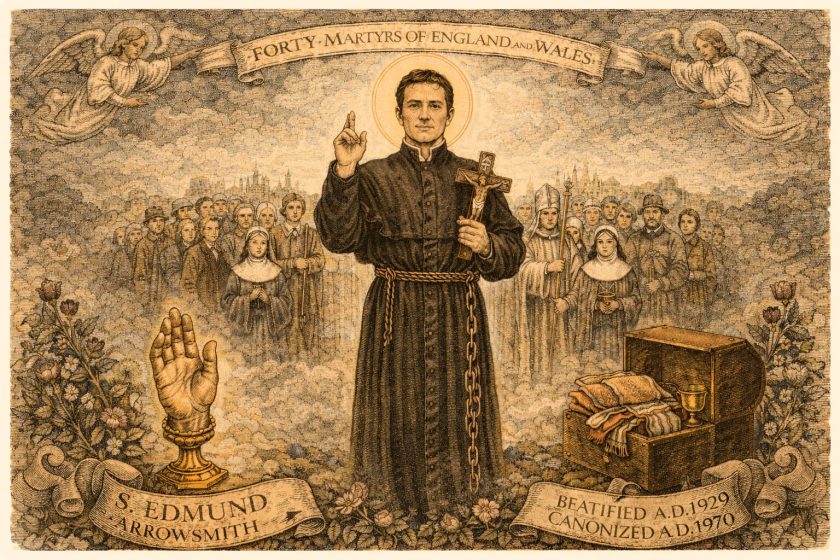
Veneration of Edmund Arrowsmith
Edmund Arrowsmit, English martyr, was born in 1585 at Haydock; executed at Lancaster, 23 August, 1628. He is of great reputation for the numerous favours, spiritual and temporal, which are won through his “Holy Hand”, still preserved as an object of veneration in the church of St. Oswald, Ashton, near the martyr’s birthplace. His parents suffered much for their religion, and the future martyr was once, when a child, left shivering in his night-clothes by the pursuivants, who carried his parents off to Lancaster jail. He entered Douai College in 1605, but ill-health compelled him to interrupt his studies; he was, however, ordained priest in 1612. Lancashire was the scene of his missionary labours and he was eminent for “fervour, zeal and ready wit.” Apprehended, probably in 1622, he was brought before Bridgeman, Protestant Bishop of Chester, and had a lively discussion with him and his ministers. Regaining his liberty he entered the Society of Jesus in 1623, and made his noviceship on the Mission, retiring to Essex for a spiritual retreat. He was eventually betrayed by false brethren, tried at Lancaster in 1628, and was found guilty of high treason for being a Jesuit priest and a seducer in religion. His fellow-prisoner, Father John Southworth, afterwards a martyr, absolved him as he went forth to undergo the butchery of his execution.
Edmund Arrowsmith was beatified in 1929. In 1970, he was canonized as one of the Forty Martyrs of England and Wales by Pope Paul VI. The latest official edition of the Roman Martyrology commemorates the martyr under the date of 28 August.[5] Since this date coincides with the feastday of St Augustine of Hippo, Edmund Arrowsmith’s is transferred in local calendars to other suitable dates: in the Diocese of Lancaster he is celebrated as one of the Lancashire Martyrs, whose feast is kept throughout the diocese on 7 August each year. He is also now commemorated in the National Calendar for England on 4 May, together with all the beatified and canonized English Martyrs.
The martyr’s hand was preserved and kept by the Arrowsmith family as a relic and it now rests in the Catholic Church of St Oswald and St Edmund Arrowsmith, Ashton-in-Makerfield. Stonyhurst College retains the small trunk of vestments and equipment which he carried from house to house.
St Edmund Arrowsmith Catholic High School is located in Ashton-in-Makerfield, Greater Manchester, England. Ironically he was educated at what is now teh site of The Byrchall high school which shares the same grounds and has a red hand as part of its heraldry. There is also St Edmund Arrowsmith Catholic Academy in Whiston, Merseyside.
This transcription is an abridged and slightly modernised version of the 1737 edition by Cornelius Murphy, S.J., itself based on an anonymous account first published in 1630, just two years after the martyrdom of Edmund Arrowsmith.
This transcription, its errors, spelling mistakes, format, omission’s and images are copyright © 2026 Steven Dowd, and is provided here for use only on the Newton-le-willows.com website.