At this period the wages of an agricultural labourer were 10d per day without food, and 5d if his master provided him with meals. Carpenters and masons received ls 6d per day. The wants of the people, however, were few, and food was cheap, and a shilling had greater purchasing power than it has in the present day. In the early part of the 18th century the manufacture of woollens and of silk was encouraged, to the detriment of cottons and calicoes, and made rapid strides. Probably about this time…
Read More >>Category: Newton-le-Willows
Newton-in-Makerfield : yr 1825-35
NEWTON IN MACKERFIELD. NEWTON IN MACKERFIELD is a small Borough Town and Chapelry in the Parish of Winwick, and in the Hundred of West Derby; 5 miles N. of Warrington, and 7 miles S. of Wigan. This Borough contains 275 houses, occupied by 289 families, consisting of 1643 persons. Of these families 56 are employed chiefly in agriculture, 221 in trade,” manufactures, or handicraft, and the remaining 13 are either engaged in professional pursuits or unemployed. The rental of the lands, messuages, and other buildings in the township, according to…
Read More >>Sites of Interest East of Newton
Sites of Interest to The East on Newton-le-Willows Site number 01 Site name Winwick to Golborne Line NGR SJ 5948 9484 to SJ 5977 9535 Site type Railway Period Post-medieval HER number MHER SJ 5994/16 Designation Sources GMAC 1995; Wardell Armstrong 2001; Ordnance Survey 1893c Description The railway was bnilt in the late nineteenth century to connect the Liverpool and Manchester railway line (Site 02) with the Warrington to Preston route. It first appears on the 1893 Ordnance Survey maps and thereafter on all subsequent Ordnance Survey…
Read More >>McCORQUODALE & CO. LTD. 1846-1937
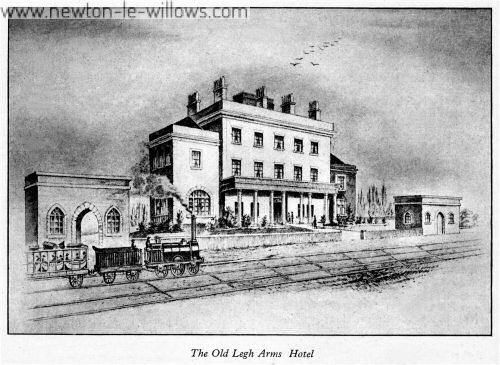
THE following appeared in a newspaper published in 1846: “The capacious building at Newton, on the north side of the Liverpool and Manchester Railway, known until recently as the “Legh Arms Hotel” is being converted into a general printing office.” A printing office in a village like Newton, however humble in pretension, a year ago would have been considered one of the greatest wonders of the age. Wonders do, however, occasionally appear, and one of the greatest we Know of is the conversion in such a place, of a building…
Read More >>Newton, 1800 & 1834
NEWTON, LANCASHIRE. Newton, commonly called Newton in the Willows, is five miles from Warrington, seven from Wigan, IS from Preston, 45 from Lancaster, and 1SS from London, in the road from Warrington to Wigan. It is an ancient borough by prescription, governed by a steward, bailiff, and burgesses, and returns two members to Parliament. The right of election is supposed to be in the burgesses, though there is no resolution of the House of Commons respecting it. The steward of the lord of the manor and the bailiff are the…
Read More >>Newton M.P. committed to the Tower of London
Its Political Importance During the 274 years from 1558 to 1832, Newton was represented by no fewer than 70 different members, and from 1678 (the year the name “Tories” was given to a political party) it was represented exclusively by 30 Tories. In this list of members are found the names of the lords of the manor?the Langtons, the Fleetwoods, and the Leghs?and many gentlemen of rank and importance in the country. It was represented for six years (1695 to 1701) by Thomas Brotherton, Esq., of Old Hey Farm, situated…
Read More >>William Huskisson (1770 – 1830)
This is the Monument that was placed beside the track, at the location of the accident, this photo is from the 1930 Centenary Memorial service The Inscription on the Monument reads : A mark of personal respect and affection has been placed here to mark the spot where, on the 15th of September 1830 at the opening of the railroad THE RIGHT HON. WILLIAM HUSKISSON M.P. singled out by an inscrutable Providence from the midst of the midst of the distinguished multitude that surrounded him, in the full pride of…
Read More >>Newton-le-Willows Official Guide
click the image to open up a new window with the copy of the 1960s map from the guide The East Lancashire Liverpool to Manchester road passes within a few hundred yards of the northern boundary of the Urban District (four main roads communicating between Newton-le-Willows and this, important arterial road) and the Warrington to Wigan trunk road, leading on to Preston and the North, passes through it. Newton-le-Willows is six and a quarter miles from Warrington, eight miles from Wigan and four and a half miles from St. Helens.…
Read More >>Locomotives or Stationary Engines
In November 1828 a report on the question of whether it would be better to work the Liverpool and Manchester Railway by stationary engines or by locomotives, was sent to George Stephenson, by the directors of that railway, these letters which I have transcribed are the replies, sent by George Stephenson and his son Robert to the report and other questions. Allthough not strictly Newton History, It shows the behind the scenes politics at a time, Imagine the course Newtons History would have run if the trains had been pulled…
Read More >>Congregational Church on Crow Lane
Whilst the old Congregational Church on Crow Lane is being rebuilt into apartments, I thought this would be the right time, to add into the website some of the information I have about it, from various sources. The Congregational Church (new), Crow Lane, c1915The first recorded preaching of the Gospel, in Newton, by a Congregational minister is given in the “Memoirs of the Rev. William Alexander,” written by his son, the Rev. John Alexander, Minister of Princes Street Chapel, Norwich, and published, in 1856, by Fletcher and Alexander of that…
Read More >>The Fee of Makerfield
THE FEE OF MAKERFIELD ; WITH AN ACCOUNT OF SOME OF ITS LORDS, THE BARONS OF NEWTON. By William Beamont, Esq. (READ FEBRUARY 22ND, 1872.) ENGLISH historians have joined chorus in ascribing to our immortal Alfred the institution of hundreds and townships into which the country is now divided. Certain it is that when he resumed the throne after his temporary retirement, and found, owing to Danish misrule, the ancient police of the country in ruin, he first set himself to readjust and settle upon their present basis the…
Read More >>Newton-in-Makerfield: P.Mannex & Co. 1871
Newton in Makerfield Is a populace and rapidly – improving locality, containing several important industrial and manufacturing establishments. The town of Newton consists chiefly of one long and broad street, pleasantly situated on a gentle eminence, and commanding extensive and panoramic views. It is about five miles from St. Helens, seven from Wigan, and near the important Railway Station of Newton Bridge. The extensive printing establishment of Messrs. McCorquodale is near the station, and in its immediate vicinity its a first- class Hotel, while the fine old Corn mill on…
Read More >>Newton le Willows in Verse – J H Lane
Today I managed to transcribe some poems written by J H Lane, which he published in 1916 in a small 40 page booklet called “Newton le Willows – Pictures and Verse”. Most of the Pictures from the book have already made it into the photo gallery, as they duplicate ones in his other two publications, as do some of the verse from the book, but here are three small sections of verse which are new to me. A Sad Mishap. PRELUDE. Near Castle Hill, that ancient mound Whose top with…
Read More >>The Bloody Stone & Mabs Cross Legend
Members of the Lancashire and Cheshire Antiquarian Society visited Winwick in June, 1909, and were shown the Bloody Stone by the leader, Captain Arthur Doggett. The report of the visit states that the stone lay on the edge of the footpath of the road leading from Newton to Winwick Church and close to the bridge crossing the railway. The local tradition then was that the Welsh knight was overtaken and killed by Sir William de Bradshaigh “on the Bloody Stone.” THE MYSTERIOUS MURDER OF SIR WILLIAM DE BRADSHAIGH A SEQUEL…
Read More >>The Battle of Winwick Pass, 19 Aug 1648
The following text is taken from a magazine I was recently sent a copy of, it included a brief but fairly full account of the Battle of Winwick Pass, the description of the historical events at Winwick preceded the main section of the magazines article, which was to set the scene historically for a Miniature WarGaming event of the Battle.I could have re-written the article to remove the War Game referances, but I decided to leave them in, because the details for numbers of soldiers, horses etc add to the…
Read More >>